If you’re recovering from a run-related injury, the right machine can help you stay active without pounding your joints. Recumbent cross trainers for injured runners are built to support low-impact cardio while still working the legs and upper body.
This roundup focuses on stable, comfortable options that can help you maintain fitness, rebuild confidence, and ease back into training at a safer pace.
Best 10 Recumbent Cross Trainers for Injured Runners Picks for 2026
Premium Clinical-Style Pick
NuStep T6MAX Recumbent Cross Trainer

- 360-degree swivel seat
- 15 magnetic resistance levels
- 600 lb weight recommendation
Best For: Runners needing a stable, highly adjustable rehab-style trainer
Compact Rehab-Friendly Pick
ECHANFIT Recumbent Cross Trainer Bike

- Dual-action handles for full-body training
- 8-level magnetic resistance
- 380 lb weight capacity
Best For: Home rehab users wanting a quieter, smaller cross trainer
Physical Therapy Style Pick
Teeter FreeStep Recumbent Cross Trainer

- Zero-impact seated stepping motion
- Patented PT-style stride
- 13 magnetic resistance levels
Best For: Recovery-focused runners wanting a PT-inspired home trainer
Family-Friendly Full-Body Pick
VANSWE Recumbent Elliptical Cross Trainer

- Moveable arms and elliptical pedals
- Bluetooth app compatibility
- 8-level magnetic resistance
Best For: Households wanting a comfortable, connected rehab-friendly trainer
Most Versatile Recovery Option
THERUN Recumbent Elliptical Bike

- Combines recumbent bike and elliptical modes
- 15.8-inch stride with padded seat and mesh backrest
- 8 resistance levels and quiet magnetic drive
Best For: runners wanting a seated, low-impact machine with multiple workout modes
Best for Gentle Rehab
Motorized Arm & Leg Elliptical Trainer

- Motorized support helps keep effort very light
- Two 60W motors with 20 speeds and presets
- Includes pedal straps and gloves for stability
Best For: seniors and injured runners needing assisted low-impact motion
Best App-Guided Trainer
Sunny Health & Fitness Smart Recumbent Bike

- Low-impact recumbent design for joint-friendly workouts
- 12-level magnetic resistance for easy intensity control
- SunnyFit app offers videos, tracking, and guidance
Best For: runners who want guided low-impact training with app support
Recovery-Friendly All-Rounder

- Dual-action arms for seated full-body cardio
- 8 magnetic resistance levels for smooth progression
- Bluetooth app support with guided workouts and routes
Best For: runners recovering from injury who want gentle full-body cardio
Feature-Packed Recovery Option

- 16 electromagnetic resistance levels for fine control
- 12 preset workouts plus 4 user programs
- Padded seat and mesh backrest for comfort
Best For: recovery-focused users who want more workout variety and higher resistance
Simple Quiet Recovery Ride
Smart Recumbent Low-Impact Trainer
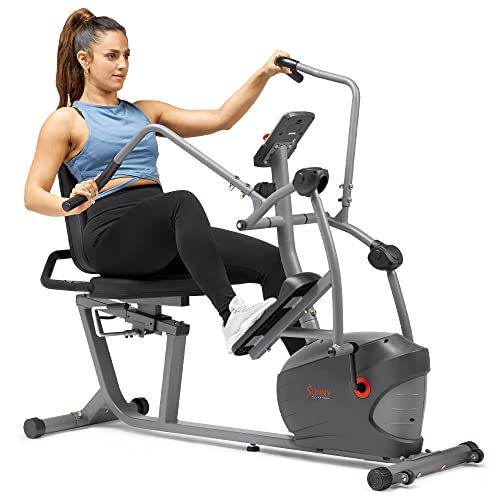
- Low-impact recumbent design for joint-friendly cardio
- 8 magnetic resistance levels with smooth adjustment
- Quiet belt drive and free SunnyFit app access
Best For: injured runners who want a simpler, quieter recovery machine
Premium Clinical-Style Pick – NuStep T6MAX Recumbent Cross Trainer
If you’re comparing recumbent cross trainers for injured runners, the NuStep T6MAX stands out as a low-impact option built for smooth full-body training. Its seated, recumbent design, adjustable arms and hand grips, and locking handles and pedals make it well suited to controlled cardio when you want to keep stress off the joints.
Best For: Runners who want a sturdy, highly adjustable, rehab-friendly cross trainer with a clinical feel.
Pros:
- 360-degree swivel seat helps with easier entry and exit.
- Adjustable arms, hand grips, locking handles, and pedals support customized positioning.
- Magnetic resistance with 15 levels offers broad workout progression.
- High 600 lb weight recommendation adds stability and capacity.
Cons:
- Very large and heavy at 295 pounds.
- Requires corded electric power.
- May be more machine than a casual home user needs.
Overall, the T6MAX is a serious recumbent cross trainer for users who prioritize adjustability, stability, and low-impact movement over portability. It fits best in a dedicated workout space where its size and feature set can be fully used.
Compact Rehab-Friendly Pick – ECHANFIT Recumbent Cross Trainer Bike
For shoppers looking at recumbent cross trainers for injured runners, the ECHANFIT recumbent exercise bike offers a practical full-body setup with dual-action handles and smooth pedaling. It aims to protect the joints while still giving you a cardio session that uses both arms and legs, which is helpful when you want gentle movement during rehab or recovery.
Best For: Injured runners who want a quieter, more compact full-body machine for home rehab and light cardio.
Pros:
- Dual-action handles create a full-body workout feel.
- Low-impact design is positioned for rehabilitation and joint-friendly training.
- 8 magnetic resistance levels let you scale intensity.
- Backlit LCD shows time, speed, distance, calories, odometer, and pulse.
Cons:
- Weight capacity is lower than some higher-end competitors at 380 lbs.
- Shorter overall feature set than premium cross trainers.
- Battery-powered console is less robust than plugged-in systems.
This is a sensible middle-ground option if you want the recumbent cross trainer format without moving into oversized, high-cost equipment. Its comfort-focused seat, transport wheels, and quiet magnetic drive make it a workable choice for regular home use.
Physical Therapy Style Pick – Teeter FreeStep Recumbent Cross Trainer
Among recumbent cross trainers for injured runners, the Teeter FreeStep is designed to feel especially gentle on the knees, back, and ankles. Its zero-impact stepping motion, patented physical therapy stride, and dual power motion make it a strong option if you’re coming back from pain or want a seated cardio machine that mirrors a rehab-oriented workout.
Best For: Injured runners who want a PT-inspired, zero-impact trainer with guided workout support.
Pros:
- Patented natural stride is licensed from commercial physiotherapy steppers.
- Zero-impact design helps reduce stress on joints and back.
- 13 magnetic resistance levels provide a wide training range.
- Free Teeter Move app adds subscription-free trainer-led workouts.
Cons:
- Rated for users up to 300 lb, which is lower than some rivals.
- Large footprint may need dedicated floor space.
- Corded electric design limits placement flexibility.
The FreeStep is best viewed as a recovery-first machine rather than a basic exercise bike substitute. If you want a low-stress, full-body trainer with a strong physical therapy angle, this model makes a compelling case.
Family-Friendly Full-Body Pick – VANSWE Recumbent Elliptical Cross Trainer
If you need recumbent cross trainers for injured runners that can also serve the whole household, the VANSWE recumbent elliptical cross trainer is built around comfort, adjustability, and app-connected tracking. Its moveable arm handles, elliptical foot pedals, and reclined seat make it easy to keep moving while limiting strain on the back, knees, and ankles.
Best For: Injured runners who want a comfortable, app-connected trainer that can fit multiple users.
Pros:
- Moveable arm handles and elliptical pedals support full-body workouts.
- Recumbent seat and padded backrest are designed for easier joint-friendly exercise.
- 8-level magnetic resistance runs quietly for home use.
- Bluetooth connectivity works with Kinomap and Zwift, with LED workout tracking.
Cons:
- Assembly and tech features may be more than some users need.
- Large size may be less convenient in small rooms.
- Weight rating in the notes is lower than the 450 lb title claim, so buyers should verify fit carefully.
For recovery workouts with a more versatile, family-shareable setup, the VANSWE offers a lot of function in one machine. It makes the most sense if you value comfort, connectivity, and adjustability more than a minimalist footprint.
Most Versatile Recovery Option – THERUN Recumbent Elliptical Bike
If you’re comparing recumbent cross trainers for injured runners, the THERUN stands out because it combines a recumbent bike and an elliptical trainer in one low-impact machine. The seated design, 15.8-inch stride, and magnetic drive are aimed at smoother movement, while the fixed-handle elliptical mode and moving-handle bike mode let you choose how much upper-body work to include.
Best For: Runners who want one machine for seated recovery workouts, low-impact conditioning, and gradual full-body training.
Pros:
- Two workout modes: fixed-handle elliptical mode and moving-handle recumbent bike mode
- 15.8-inch stride and padded seat with mesh backrest for more comfortable seated use
- 8 resistance levels plus bidirectional motion for flexible training intensity
- Magnetic flywheel system runs at 20 dB or less for quieter home workouts
Cons:
- At 100 pounds, it is a substantial piece of home equipment
- Best suited to users within the listed height range of 4.76 ft to 6.23 ft
Overall, this is a versatile option if you want a recumbent cross trainer that can ease you back into cardio without high-impact strain. The combination of support, resistance control, and full-body movement gives it broad appeal for recovery-focused training.
Best for Gentle Rehab – Motorized Arm & Leg Elliptical Trainer
For injured runners who need very gentle movement, this recumbent cross trainer alternative is built around motorized arm-and-leg exercise rather than traditional self-powered pedaling. The dual 60W motors, 20 speed settings, and forward/backward operation make it useful when the goal is mild, controlled motion for recovery and mobility work.
Best For: Seniors, rehab users, and runners who need a very low-effort seated trainer for arms and legs.
Pros:
- Motorized design provides assisted movement for upper and lower limbs
- Two 60W motors support training together or separately, forward or backward
- 20 speed settings and P1-P3 presets for quick intensity changes
- Includes pedal straps and gloves for added stability during use
Cons:
- Maximum weight recommendation is 220 pounds
- More of a rehab exerciser than a full-featured cardio machine
- Stride length is 13.8 inches, which is shorter than some larger trainers
This is a practical pick when your priority is gentle, seated movement rather than a demanding workout. It makes the most sense for recovery routines, light daily activity, and users who want help keeping motion smooth and manageable.
Best App-Guided Trainer – Sunny Health & Fitness Smart Recumbent Bike
Among recumbent cross trainers for injured runners, this Sunny Health & Fitness model focuses on low-impact full-body work with a familiar recumbent setup. It offers arm and leg exercisers, a 12-level magnetic resistance system, and an easy on-off design, making it a straightforward choice for controlled indoor recovery sessions.
Best For: Runners who want a stable recumbent trainer with app-based workouts and adjustable resistance.
Pros:
- Recumbent design is intended to be gentle on joints
- Full-body setup lets you work upper and lower body together or separately
- 12 magnetic resistance levels for more precise workout control
- SunnyFit app adds workout videos, tracking, and trainer guidance
Cons:
- Large footprint at 66.9 inches deep and 100 pounds in weight
- Arms move when you stop pedaling, which may not suit every workout style
This is a strong option if you want a recumbent cross trainer that blends rehab-friendly mechanics with guided workouts. The app connection and easy-access frame make it especially appealing for users who want structure while rebuilding fitness.
Recovery-Friendly All-Rounder – Full-Body Low-Impact Trainer
If you’re comparing recumbent cross trainers for injured runners, this JLL model stands out for its seated, joint-friendly full-body design. The dual-action arm exercisers let you keep training while reducing impact, and the magnetic resistance makes it easy to start gently and progress at your own pace.
Best For: runners who want a quiet, low-impact recumbent trainer with arm-and-leg coordination and app-based workout guidance.
Pros:
- Dual-action arm exercisers support full-body training without high joint stress.
- 8-level magnetic resistance provides smooth, controlled workout progression.
- Wide cushioned seat, backrest, and low step-through design improve comfort and access.
- Bluetooth app connectivity adds guided workouts, scenic routes, and metric syncing.
Cons:
- Weight capacity tops out at 265 lbs, which is lower than some alternatives.
- Console is functional, but the feature set is more practical than premium.
This is a strong pick if your priority is staying active during recovery with a stable, quiet machine that doesn’t ask much from tired joints. It balances comfort, versatility, and simple resistance control well for home rehab-style cardio.
Feature-Packed Recovery Option – Elite Recumbent Cross Trainer
For injured runners seeking recumbent cross trainers for injured runners, this Sunny Health & Fitness model offers a useful mix of low-impact movement, adjustable intensity, and app-based workout variety. The recumbent elliptical format combines arm and leg training while keeping the ride seated and joint-friendly.
Best For: users who want a higher-capacity recumbent cross trainer with more resistance levels and structured workout options.
Pros:
- 16 electromagnetic resistance levels offer a wider intensity range than basic models.
- 12 built-in workouts plus up to 4 user programs add structured training variety.
- Easy step-through layout and adjustable seat make setup and changes simple.
- Mesh backrest and padded seat improve comfort for longer sessions.
Cons:
- Larger footprint may be less ideal for tight spaces.
- More features can mean a steeper learning curve than simpler machines.
This is the most feature-rich option in the group, especially if you want a broader resistance range and programmed workouts to follow during recovery. It’s a solid choice when you need low impact but still want room to grow your training.
Simple Quiet Recovery Ride – Smart Recumbent Low-Impact Trainer
This Sunny Health & Fitness recumbent option is a practical fit for injured runners who want low-impact movement with simple resistance control. It pairs arm and leg exercisers with a quiet belt-drive system, making it a straightforward choice for home cardio during rehab or return-to-training phases.
Best For: runners who want a quieter, simpler recumbent trainer with basic resistance and app access.
Pros:
- Low-impact design helps protect joints while keeping cardio work accessible.
- 8 levels of magnetic resistance provide easy workout adjustments.
- Belt-drive system is designed for smooth, quiet operation.
- Free SunnyFit app access adds workouts, scenic routes, and progress tracking.
Cons:
- Fewer resistance levels than the Elite Sunny model.
- Feature set is more basic than the higher-end cross trainer option.
If you want a no-fuss machine that still supports full-body, low-impact exercise, this model gets the fundamentals right. It’s especially appealing for users who value quiet operation and simple training over advanced programming.
How We Picked the Best Recumbent Cross Trainers for Injured Runners
For injured runners, the best recumbent cross trainers balance comfort, stability, adjustable resistance, and easy entry and exit. We prioritized models that support upright posture, smooth motion, and full-body engagement without aggressive impact. We also looked for features that matter during recovery, such as back support, arm levers, pedal comfort, and user-friendly controls.
Quick Comparison
At a glance, some Recumbent Cross Trainers for Injured Runners are better for gentle rehab and daily movement, while others are better for rebuilding stamina and cross-training. More compact machines suit home use and lighter recovery work, while higher-capacity models are often better for long-term durability, larger users, or shared households.
Key Buying Factors for Recumbent Cross Trainers for Injured Runners
Low-Impact Motion
Choose a machine that keeps joint stress low and encourages smooth, controlled movement. If your injury affects the knees, hips, ankles, or lower back, prioritizing a seated design with a natural stride or pedal path is essential.
Seat Comfort and Support
A recumbent seat should feel stable, adjustable, and comfortable enough for longer sessions. Good lumbar support and easy seat positioning can make a major difference during recovery.
Resistance Range
Look for enough resistance to start gently and progress over time. Injured runners often benefit from machines that allow very light effort early on, then increase gradually as strength returns.
Upper-Body Engagement
Moving the arms can help add conditioning without extra impact, but it should never force awkward posture. For many users, adjustable arm resistance and natural grip positions are ideal.
Size, Capacity, and Stability
If you are comparing Recumbent Cross Trainers for Injured Runners, check the weight limit, seat height, and footprint. A stable frame and easy step-through access matter as much as workout features.
Who Should Buy Which Recumbent Cross Trainers for Injured Runners?
If you want the gentlest option for rehab or returning to movement after injury, choose a model with smooth resistance, supportive seating, and simple controls. If you want a more complete cardio workout, consider a fuller-featured cross trainer with arm exercisers and multiple resistance levels. Taller users, heavier users, and households that plan to share the machine should lean toward higher-capacity models with wider adjustability. For anyone balancing recovery and long-term fitness, the best choice is the one that feels comfortable enough to use consistently.