Finding the right treadmill is easier when you focus on comfort, controls, stability, and the amount of space you actually have. The best treadmills for beginners make it simple to start walking or jogging without overwhelming setup or complicated features.
This roundup includes full-size home treadmills, folding walking pads, and compact incline models, so you can match your first machine to your fitness goals, room size, and budget.
Best 10 Treadmills for Beginners Picks for 2026
Best Guided Treadmill

- Up to 10 MPH with 0–10% incline
- Cushioned 55-inch deck
- iFIT guided workouts and auto-adjustments
Best For: Beginners progressing from walking to running
Best Supported Incline Treadmill

- Automatic 0–12% incline
- Extended dual handrails for stability
- 375-pound capacity and compact storage
Best For: Beginners needing support in small spaces
Best Compact Walking Pad

- Slim, lightweight design for small spaces
- Up to 4 MPH for walking routines
- Remote control and LED workout display
Best For: Beginners building a simple walking habit
Best Simple Incline Walking Pad

- Manual 12% incline for added challenge
- Handle bars and cushioned deck
- Folds to four inches for storage
Best For: Beginners wanting compact supported walking
Compact Starter Pick

- 0.6–6.2 MPH range with 12 preset programs
- Folds for storage in small rooms
- Safety handlebar and cushioned non-slip belt
Best For: Beginners needing a compact treadmill for walking and light jogging
High-Capacity Choice
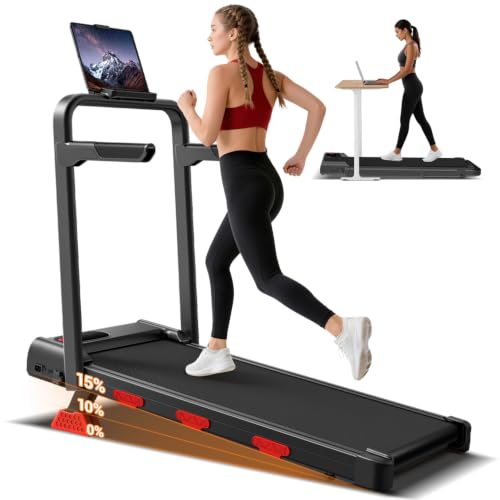
- 350-pound stated weight capacity
- Flat, 10%, and 15% manual incline positions
- Quiet brushless motor rated below 45 dB
Best For: Beginners wanting quiet walking workouts and higher weight capacity
Smart-Control Pick

- Handlebar, remote, app, and voice controls
- Automatic belt alignment and five-layer cushioning
- App syncing with WELLFIT, KINOMAP, and Apple Health
Best For: Beginners wanting convenient controls and connected fitness tracking
Best Incline Value
Aiteid Compact Incline Treadmill

- Manual 12% incline
- 300-pound capacity
- 48-pound foldable design
Best For: Beginners wanting compact walking and light-jogging workouts with hill training
Best Space-Saving Starter
Foldable Walking Pad with Handle Bar

- 5.2-inch folded profile
- 12 programs and countdown modes
- Shock-absorbing belt system
Best For: Beginners in apartments or small homes who need a foldable walking and jogging treadmill
Best for Stability

- 16% manual incline
- 330-pound capacity
- Long padded handrails
Best For: Beginners and seniors seeking supported walking with adjustable hill training
Best Guided Treadmill – NordicTrack T Series T5
For beginners who want room to progress beyond walking, the NordicTrack T Series T5 combines speeds up to 10 MPH, a 0–10% incline, and cushioned deck support. Its LCD display works independently, while iFIT adds guided workouts and automatic adjustments through a compatible phone or tablet with a required membership.
Best For: Beginners who want a traditional home treadmill with guided training and room to build toward jogging or running.
Pros:
- 10 MPH maximum speed supports walking, jogging, and running.
- 0–10% incline range adds variety and increases workout intensity.
- KeyFlex cushioning is designed to reduce impact during daily use.
- iFIT offers guided workouts, SmartAdjust, and app connectivity with a membership.
Cons:
- Many smart features require an iFIT Train Membership.
- The 55-by-18-inch deck may feel less spacious than larger running treadmills.
- At 130 pounds, it may not be convenient to move frequently.
This is the most versatile option in the group for beginners who expect their workouts to evolve. Choose it if you value guided programming and running capacity more than an ultra-compact footprint.
Best Supported Incline Treadmill – WELLFIT Foldable Walking Pad
The WELLFIT is a beginner-friendly choice for home workouts when balance, storage, and incline flexibility matter. It has extended dual handrails, automatic 0–12% incline, a 0.6–7.6 MPH speed range, and a foldable frame that can be stored in compact spaces.
Best For: Beginners, seniors, and apartment users who want added handrail support and incline training in a space-saving treadmill.
Pros:
- Extended dual handrails provide extra balance and stability.
- Automatic 0–12% incline supports gradual progression.
- Quiet brushless motor operates below 40 dB and supports up to 375 pounds.
- Folded height of 5.5 inches makes under-bed or wall storage practical.
Cons:
- The 7.6 MPH maximum is better suited to walking and moderate jogging than fast running.
- The 40-by-16-inch belt offers less length than a conventional running treadmill.
- Some app and virtual-workout features depend on compatible services.
With its supportive rails and automatic incline, the WELLFIT is especially approachable for beginners who want more stability than a flat walking pad provides. Its compact storage design also suits apartments and home offices.
Best Compact Walking Pad – XM-A1 Mini Treadmill
If your beginner routine starts with simple walking, the XM-A1 is a compact, low-profile option for home or office use. Its 1–6 km/h speed range, remote control, LED display, and slim 4.33-inch height make it easy to use while working or store under furniture.
Best For: Beginners focused on light walking, desk-time movement, and storage in very small spaces.
Pros:
- Compact profile fits under beds, sofas, desks, or cabinets.
- Lightweight 36.4-pound design and transport wheels simplify moving.
- Quiet motor and steel frame support home or office use.
- Shock absorbers and a five-layer anti-slip belt add walking comfort.
Cons:
- Its 4 MPH maximum speed is intended for walking rather than running.
- The 38.5-by-94 cm walking area is relatively short and narrow.
- It does not provide an incline feature or full-length handrails.
The XM-A1 keeps the learning curve and storage demands low, making it a sensible entry point for daily steps. It is best viewed as a walking pad, not a treadmill for progressing into regular running.
Best Simple Incline Walking Pad – ANCHEER Foldable Treadmill
The ANCHEER offers a straightforward starting point for beginners who want walking workouts with a little more challenge. Its 0.6–4 MPH speed range, manual 12% incline, handle bars, cushioned deck, and four-inch folded profile make it suitable for compact home or office routines.
Best For: Beginners who want supported walking, manual incline training, and easy storage without a full-size treadmill.
Pros:
- Manual 12% incline adds intensity without requiring a large treadmill.
- Handle bars provide extra steadiness during walking.
- Multi-layer cushioning is designed to reduce impact on joints.
- Lightweight, wheeled frame folds to four inches for storage.
Cons:
- The 4 MPH maximum speed limits it primarily to walking.
- Incline adjustment is manual rather than automatic.
- The 14-inch belt is narrower than many traditional treadmill decks.
For beginners who prefer simple controls and occasional incline work, the ANCHEER is an approachable compromise between a flat walking pad and a full treadmill. Its compact form is particularly useful when the machine must be put away after each session.
Compact Starter Pick – Foldable Incline Walking Pad
For beginners comparing treadmills for beginners, this compact walking pad offers a straightforward way to add walking, light jogging, or short running sessions at home. Its 0.6–6.2 MPH speed range, 12 preset programs, safety handlebar, and foldable design make it practical for small spaces.
Best For: Beginners who want a compact treadmill for walking, light jogging, and home workouts.
Pros:
- 12 preset programs and three countdown modes help structure workouts.
- Manual incline supports added workout intensity.
- Folds to 40.5 x 18 x 4.7 inches and includes transport wheels.
- Five-layer non-slip belt and cushioning system support more comfortable sessions.
Cons:
- The 35 x 14-inch running area is narrower than the other options here.
- The 220-pound weight capacity may limit suitability for some users.
- Manual incline requires changing the support feet by hand.
This is a sensible entry-level choice when storage space and simple controls matter most. It supports more than basic walking, but its narrower deck and lower weight capacity are worth checking before purchase.
High-Capacity Choice – Quiet Incline Walking Pad
Among treadmills for beginners, the LONTEK stands out for its high stated weight capacity, quiet brushless motor, and adjustable manual incline. It is designed for walking, light jogging, and under-desk use while remaining slim enough for apartments, offices, and other compact spaces.
Best For: Beginners who prioritize a high weight capacity, quiet operation, and flexible walking intensity.
Pros:
- Supports up to 350 pounds according to the supplied specifications.
- Manual setup offers flat, 10%, or 15% incline positions.
- Brushless motor operates below 45 dB as stated in the product notes.
- 37.4 x 15-inch cushioned belt includes side impact strips.
Cons:
- Incline changes are manual rather than electronically controlled.
- Top speed is 6.2 MPH, so it is oriented more toward walking and light jogging.
- The supplied bullet description is truncated, so some feature details are not fully specified.
This model is appealing for beginners who want extra capacity and incline options without a bulky traditional treadmill. Its manual incline system keeps operation simple, though users seeking automatic incline adjustments should look elsewhere.
Smart-Control Pick – Cushioned Folding Treadmill
For beginners looking for treadmills for beginners with convenient controls, the WELLFIT combines handlebar buttons, a remote, app control, and app voice control. Its 36 x 16-inch cushioned belt, automatic belt alignment, manual incline, and fitness-app connectivity make it well suited to regular home walking and light jogging.
Best For: Beginners who want easy controls, joint-conscious cushioning, and app-based progress tracking.
Pros:
- Four control methods reduce the need to bend or interrupt a workout.
- Five-layer anti-shock belt is designed to reduce impact on knees and ankles.
- Automatic belt alignment helps keep the belt centered without tools.
- Syncs with WELLFIT, KINOMAP, and Apple Health, with lifetime tech support listed.
Cons:
- Its 6.2 MPH maximum speed is better suited to walking and light jogging than fast running.
- The incline is manual and reaches a maximum of 10%.
- App features may be unnecessary for beginners seeking the simplest possible setup.
This is the most feature-rich option of the three for beginners who value convenience and digital tracking. The handlebar controls and self-aligning belt are practical advantages, while the compact deck and 6.2 MPH limit keep it focused on everyday home exercise.
Best Incline Value – Aiteid Compact Incline Treadmill
For beginners comparing treadmills for beginners, the Aiteid combines a compact footprint with a manual 12% incline, simple controls, and a top speed of 6.2 MPH. Its lightweight frame and transport wheels make it practical for home or apartment use.
Best For: Beginners who want walking, light jogging, and hill-style workouts in a compact machine.
Pros:
- Manual incline reaches 12% for more challenging walks.
- Quiet brushless motor is rated for operation at noise levels around 55 dB.
- Supports up to 300 pounds and includes 12 preset programs.
- Folds to a 5.5-inch height and weighs 48 pounds.
Cons:
- The 39-inch belt may feel limited for users with a long running stride.
- Incline adjustment is manual rather than motorized.
This is a strong entry-level option when storage, noise, and incline flexibility matter more than a full-size running deck. The 6.2 MPH maximum is better suited to walking and moderate jogging than sustained fast running.
Best Space-Saving Starter – Foldable Walking Pad with Handle Bar
This foldable model is a practical pick among treadmills for beginners, offering a straightforward 0.6–6.2 MPH range, supportive handrails, and preset programs. Its slim folded profile is especially useful in apartments, dorms, and small homes.
Best For: New users who prioritize easy storage, balance support, and walking-to-jogging workouts.
Pros:
- Folds to a 5.2-inch profile and rolls on built-in wheels.
- Six shock absorbers and five silicone pads help cushion impacts.
- Includes 12 automatic programs and three countdown modes.
- Reinforced handrails provide added stability.
Cons:
- Its 220-pound weight capacity is lower than the other listed options.
- The motor is rated at 0.75 HP continuous power, which may suit moderate use better than intense training.
- There is no stated warranty in the supplied details.
Choose this treadmill when compact storage and beginner-friendly controls are the priorities. The narrower 39-by-15-inch belt and 6.2 MPH ceiling make it more appropriate for walking and casual jogging than serious running.
Best for Stability – X5F Incline Walking Pad
For beginners shopping for treadmills for beginners, the X5F stands out for its long padded handrails, low 0.6 MPH starting speed, and high manual incline. It also combines a foldable design with a 330-pound capacity for a broad range of home users.
Best For: Beginners, seniors, and users who want extra handrail support and adjustable hill training.
Pros:
- Manual incline adjusts up to 16% for more demanding walks.
- Long padded side handrails support balance during low-speed workouts.
- 330-pound capacity and a 2.5 HP motor suit regular home use.
- Includes a seven-layer cushioned belt, remote control, and one-year warranty.
Cons:
- The 35.8-inch belt is relatively short for running.
- Incline adjustment is manual rather than powered.
- The 15.2-inch belt width may feel narrow for some users.
The X5F is a sensible beginner choice when stability and incline range are more important than a spacious running surface. Its modest 6.3 MPH top speed keeps the focus on walking and light jogging, while the foldable frame helps preserve floor space.
How We Picked the Best Treadmills for Beginners
We focused on the features that matter most when starting a home walking or jogging routine: straightforward controls, a stable handrail or frame, usable belt space, incline options, folding or compact designs, and speed ranges appropriate for walking and light running. We also considered how each format fits different homes, from apartments and home offices to dedicated workout spaces.
Because specifications can vary by model or seller, verify the current maximum speed, user-weight rating, assembled dimensions, warranty, and return policy before buying.
Quick Comparison
| Type | Best For | Main Advantage | Watch For |
|---|---|---|---|
| Full-size treadmill | Regular walking or jogging | More stable frame and larger deck | Requires more floor space |
| Folding treadmill | Small home gyms | Can be stored between workouts | Check folded dimensions and lifting weight |
| Walking pad | Office use and casual walking | Compact, portable design | Often less suitable for fast running |
| Incline walking pad | Low-impact conditioning | More workout intensity without running | Confirm incline operation and stability |
Key Buying Factors for Treadmills for Beginners
Speed and Workout Goals
For comfortable walking, a modest top speed is usually sufficient. If you expect to jog, choose a model with a higher maximum speed and a deck long enough for your stride. Do not pay for running performance if your plan is primarily desk-side walking.
Deck Size and Stability
A longer, wider belt generally feels more forgiving, especially for taller users or anyone who is still building confidence. Handrails can make starting and stopping easier, but they should not replace a stable base. Place the treadmill on a level surface and leave clearance around it.
Incline and Controls
Incline can increase effort during a walking workout while keeping speeds moderate. Automatic incline is convenient, but confirm how it is adjusted and whether the treadmill must be stopped first. Large, clearly labeled controls are particularly useful for beginners.
Storage, Noise, and Safety
Measure both the operating and folded footprint. A lightweight walking pad may be easier to move, while a heavier frame is often steadier. Look for an emergency safety key, nonslip footing, and a motor suited to your expected use. Consider noise if you live above others or plan to work nearby.
Who Should Buy Which Treadmills for Beginners?
Choose a Full-Size Treadmill If…
You want the most stable option for frequent walking or light jogging and have room for a permanent or semi-permanent setup.
Choose a Folding Model If…
You need a conventional treadmill but want to reclaim floor space after each workout. Prioritize easy folding and a manageable storage position.
Choose a Walking Pad If…
You mainly want casual walking, under-desk movement, or a compact machine for an apartment. Select a model with a handlebar if balance and support are priorities.
Choose an Incline Model If…
You want more challenging walks without relying on high speeds. Make sure the elevated position still feels secure and that the incline matches your available clearance.