The best treadmills make it easier to walk, run, or train consistently at home, but the right model depends on your available space, fitness goals, and budget.
Our roundup includes full-size home treadmills, compact walking pads, folding designs, and incline-focused options so you can match features to your routine.
Best 10 Treadmills Picks for 2026
Connected Home Runner

- 10 MPH top speed and 0–10% incline
- KeyFlex cushioning and foldable frame
- iFIT connectivity with app syncing
Best For: Guided home workouts and moderate running
Compact Smart Trainer

- 10 MPH speed and 0–10% incline
- ProShox cushioning and foldable design
- iFIT SmartAdjust and app syncing
Best For: Connected workouts in smaller home spaces
Small-Space Walking Pick
Incline Walking Pad with Handle Bar

- 0.6–3.8 MPH walking speed
- Manual 4-degree incline and support handles
- Folds for compact storage and operates quietly
Best For: Light walking in small homes or offices
Higher-Speed Home Runner
ProForm Carbon 12 MPH Treadmill

- 12 MPH top speed for faster running
- 0–12% incline and 60-by-20-inch deck
- 7-inch display with foldable iFIT design
Best For: Endurance training and faster home running
Heavy-Duty Pick

- 400-pound capacity with a 3.5 HP brushless motor
- 20% automatic incline for uphill workouts
- Shock-absorbing belt and adjustable-height handles
Best For: Heavy-duty home incline training
Small-Space Pick
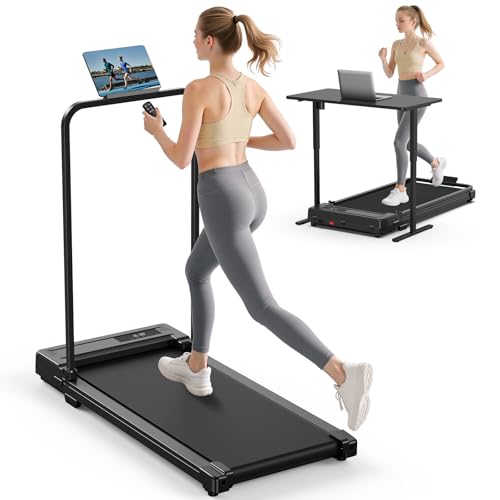
- Folds compactly for home or office storage
- Handlebar lowers or removes for under-desk use
- Supports walking speeds up to 4 mph
Best For: Daily walking and limited-space setups
Incline Value Pick

- 0%, 10%, and 18% manual incline options
- 3.0 HP motor with 400-pound capacity
- Folds compactly and arrives 90% assembled
Best For: Versatile incline workouts in smaller spaces
Best Compact Pick
Compact Walking Pad for Small Spaces

- Quiet 2.5HP motor with speeds up to 4 mph
- Slim, lightweight design with transport wheels
- Remote control and LED workout tracking
Best For: Small-space walking at home or under a desk
Best Foldable Value

- Walking, jogging, and running modes up to 4 mph
- Foldable frame with front transport rollers
- Quiet motor with shock-absorbing belt system
Best For: Flexible home or office workouts in compact spaces
Best Handlebar Design
Foldable Walking Pad with Handlebar

- Handlebar lowers for under-desk use
- Three workout modes up to 4 mph
- 265-pound capacity with shock-absorbing belt
Best For: Compact workouts with added handlebar support
Connected Home Runner – NordicTrack T Series T6.5S
The NordicTrack T Series T6.5S is a versatile treadmill for home cardio, combining 10 MPH speeds, a 10% incline, cushioning, and a foldable frame. Its strongest feature is the iFIT ecosystem, although a membership is required for trainer-led automatic adjustments and connected features.
Best For: Home users who want guided workouts, moderate running speeds, and a foldable treadmill with app connectivity.
Pros:
- Reaches speeds up to 10 MPH with digital quick controls.
- Offers a 0–10% incline range for added intensity.
- KeyFlex cushioning and a 55-by-20-inch deck support more comfortable strides.
- Folds for easier storage and supports iFIT, Strava, Garmin, and Apple Health connections.
Cons:
- iFIT membership is required for many smart and trainer-controlled features.
- The 5-inch LCD display is functional but relatively small.
- At 203 pounds, it may be difficult to move frequently.
Choose this model if you want a connected treadmill with useful incline and speed controls without moving into higher-speed running equipment. Its 300-pound weight recommendation and compact folding design make it practical for many home setups.
Compact Smart Trainer – ProForm Carbon Treadmill
This ProForm Carbon treadmill is designed for home users who want a compact, connected treadmill for walking, jogging, and running. It provides speeds up to 10 MPH, a 10% incline, ProShox cushioning, and a folding frame, while iFIT adds interactive training when the required membership is active.
Best For: Small-space home gyms seeking an app-connected treadmill with automatic workout adjustments.
Pros:
- Supports speeds up to 10 MPH and incline settings up to 10%.
- ProShox cushioning helps reduce impact during workouts.
- Folding design, device shelf, and compact dimensions suit limited spaces.
- Includes iFIT features such as SmartAdjust, ActivePulse, AI coaching, and fitness-app syncing with membership.
Cons:
- Many connected features require an iFIT Train Membership.
- The 18-inch deck width is narrower than some larger running treadmills.
- The 5-inch display provides less viewing area than larger console screens.
This is a practical middle-ground treadmill for users who value guided workouts and easy storage. It is especially appealing when interactive training matters more than a higher maximum speed or a larger running deck.
Small-Space Walking Pick – Incline Walking Pad with Handle Bar
This compact walking pad is built for low-speed home or office exercise rather than fast running. It combines a 0.6–3.8 MPH range with a manual 4-degree incline, folding handles, an LED display, and quiet operation rated at 45 dB.
Best For: Walking, light incline exercise, and under-desk-style use in apartments, offices, or other small spaces.
Pros:
- Compact folding design takes up less than 0.5 square meters for storage.
- Handles provide added support, while the manual incline increases walking intensity.
- LED display tracks time, distance, speed, and calories.
- Quiet brushless-motor operation is rated at 45 dB and includes a one-year motor warranty.
Cons:
- The 3.8 MPH maximum speed is intended for walking, not running.
- The plastic frame may feel less substantial than full-size treadmill construction.
- Incline adjustment is manual rather than electronically controlled.
If your priority is convenient daily movement in a tight space, this walking pad is easier to store than a conventional treadmill. Its low speed and compact format make it better suited to walking routines than vigorous cardio training.
Higher-Speed Home Runner – ProForm Carbon 12 MPH Treadmill
This ProForm Carbon treadmill is the strongest running-oriented option in this group, with a 12 MPH top speed, 12% incline, 7-inch LCD display, and 60-by-20-inch deck. Its foldable frame and iFIT compatibility add convenience for home workouts, though the connected coaching features require a membership.
Best For: Home runners who want more speed, incline range, and deck length for endurance-focused training.
Pros:
- 12 MPH maximum speed accommodates faster running workouts.
- 0–12% incline range provides more intensity and terrain variation.
- The 60-by-20-inch deck offers useful room for running strides.
- Includes ProShox cushioning, a 7-inch display, folding storage, and iFIT workout controls.
Cons:
- iFIT Train Membership is required for automatic trainer control and other connected features.
- At 221 pounds, the treadmill is substantial to move.
- Its larger footprint may require more dedicated floor space than compact walking models.
For buyers comparing treadmills for regular running, this model stands out through its higher speed and larger deck. It is a better fit for progressive cardio and endurance training than for occasional walking or very limited spaces.
Heavy-Duty Pick – 3.5 HP 20% Incline Treadmill
For shoppers comparing treadmills for challenging home workouts, this model combines a 3.5 HP brushless motor, speeds up to 8.7 mph, and a 20% automatic incline. Its 400-pound capacity, adjustable-height handles, and shock-absorbing running board make it a practical option for users who want a sturdier treadmill in a relatively compact format.
Best For: Heavy-duty home walking, jogging, and incline training, especially for users who need a higher weight capacity.
Pros:
- Supports up to 400 pounds and uses a quiet 3.5 HP brushless motor.
- 20% automatic incline adds uphill training without manual adjustment.
- Seven-layer running belt and shock absorption help cushion workouts.
- Pause function retains workout data, while the app and built-in speaker add convenience.
Cons:
- The 41 x 16.1-inch belt is narrower than some full-size running surfaces.
- Its maximum speed of 8.7 mph may not suit dedicated speed runners.
Choose this treadmill if incline work, capacity, and home-use durability matter more than a large commercial-style deck. It arrives 90% assembled and includes transport wheels for easier placement.
Small-Space Pick – Compact Folding Walking Pad
This walking pad is one of the more space-conscious treadmills for home offices, apartments, and under-desk use. It runs from 1 to 6 km/h, includes a supportive handlebar, and folds to a compact 104 x 47 x 10.5 cm size for storage beneath compatible furniture.
Best For: Daily walking, light jogging, standing-desk use, and users with limited storage space.
Pros:
- Compact folding design with built-in wheels makes repositioning easier.
- Handlebar can be lowered or removed for under-desk walking.
- Five-layer cushioned belt provides a 90 x 38 cm exercise surface.
- LED display, remote control, and pause function help simplify workouts.
Cons:
- The 4 mph maximum speed is intended for walking and light jogging rather than fast running.
- The 264-pound weight limit is lower than the heavy-duty options in this roundup.
With its modest 440W motor and portable design, this walking pad is best viewed as a convenient daily-steps machine rather than a full running treadmill. Its removable handlebar gives it more setup flexibility than many compact pads.
Incline Value Pick – LONTEK 18% Foldable Treadmill
Among treadmills designed for varied home workouts, the LONTEK SF20 stands out for its adjustable 0% to 18% incline and 0.6 to 7.5 mph speed range. It supports walking, climbing, jogging, and running, while its foldable design and 90% pre-assembly help make it suitable for smaller rooms.
Best For: Users who want incline variety, multiple workout modes, and a foldable treadmill for home use.
Pros:
- Manual incline settings of 0%, 10%, and 18% provide workout variety.
- 3.0 HP brushless motor supports up to 400 pounds and is rated below 45 dB.
- Seven-layer belt and shock-absorbing components are designed to reduce joint impact.
- Folds to 44.3 x 21.8 x 4.1 inches and includes built-in wheels.
Cons:
- Incline adjustment is manual and requires the included attachments.
- The 15 x 37.5-inch belt may feel short or narrow for longer-stride runners.
This is a flexible choice for households that want more than flat walking but do not need a full commercial treadmill. Its strong capacity and fold-away profile are appealing, though runners should consider whether the compact belt suits their stride.
Best Compact Pick – Compact Walking Pad for Small Spaces
If you need treadmills for a home office, apartment, or bedroom, this compact walking pad emphasizes quiet operation and easy storage. Its slim, lightweight design fits beneath furniture, while the remote and LED display keep basic workout controls and metrics accessible.
Best For: Walking while working or exercising in smaller rooms where portability and low storage space matter.
Pros:
- Quiet 2.5HP motor supports speeds from 0.6 to 4 mph and up to 264 pounds.
- Slim 42.91-by-19.69-inch footprint stores under a bed, sofa, desk, or cabinet.
- Five-layer anti-slip belt, silicone shock absorbers, and rubber cushioning help improve walking comfort.
- Arrives ready to use and includes a remote control plus LED workout display.
Cons:
- Its 4 mph maximum speed is oriented toward walking rather than faster running.
- The 38.5-by-94 cm walking area may feel narrow for some users.
This is a practical choice among compact treadmills when quiet walking, straightforward controls, and easy room-to-room movement take priority over high-speed training.
Best Foldable Value – 3-in-1 Foldable Walking Pad
This foldable treadmill offers three speed ranges for walking, jogging, and running at home or in the office. The compact frame, front rollers, and under-bed storage design make it one of the more flexible treadmills for small spaces, while the LED display tracks essential workout information.
Best For: Users who want one compact machine for walking, jogging, and light running with flexible storage.
Pros:
- Three modes cover walking from 0.6 to 1.5 mph, jogging from 1.5 to 2.5 mph, and running from 2.5 to 4 mph.
- Quiet 2.0HP motor and steel frame are designed to reduce vibration and noise.
- Foldable construction and front transport rollers simplify movement and storage.
- Honeycomb shock absorption and a multilayer anti-slip PVC belt support a more cushioned workout.
Cons:
- Its 242-pound maximum load is lower than some comparable walking pads.
- The 4 mph maximum speed limits it to light running rather than performance training.
The combination of three exercise modes and a foldable profile makes this a versatile option for everyday indoor fitness, especially when floor space is limited.
Best Handlebar Design – Foldable Walking Pad with Handlebar
For shoppers comparing treadmills with more traditional handling, this foldable walking pad adds a handlebar, a detachable phone holder, and three workout modes. Lowering the handrails lets it function under a desk, while transport wheels and a compact folded size support storage in apartments or offices.
Best For: Users who want the added support of a handlebar but still need an under-desk treadmill for compact spaces.
Pros:
- Quiet 2.0HP motor provides walking, jogging, and running speeds up to 4 mph.
- Handlebar can be lowered for under-desk use, and the detachable phone holder supports multitasking.
- 90-by-38 cm belt and 265-pound capacity suit daily indoor workouts.
- Multilayer anti-slip belt and honeycomb shock absorbers help reduce impact and running noise.
Cons:
- The 4 mph maximum speed is not intended for fast running workouts.
- Its folded dimensions still require approximately 104-by-48.7-by-10.5 cm of storage space.
This model stands out for combining a supportive handlebar with under-desk flexibility, making it a useful middle ground between a basic walking pad and a conventional compact treadmill.
How We Picked the Best Treadmills
We focused on practical differences that matter in everyday home use: running surface, motor capability, speed and incline options, weight capacity, folding design, portability, and space requirements. The selection includes established home-fitness lines such as NordicTrack and ProForm alongside compact walking-pad designs and higher-capacity incline Treadmills.
Because product specifications and availability can vary by seller, confirm the current dimensions, maximum user weight, warranty, and included features before ordering. Pay particular attention to whether an incline is motorized or manual and whether the advertised horsepower reflects continuous-duty performance.
Quick Comparison
| Best for | Look for | Recommended style |
|---|---|---|
| Daily walking | Quiet operation, simple controls, reliable belt | Compact treadmill or walking pad |
| Desk walking | Low profile, remote control, easy storage | Under-desk walking pad |
| Jogging and running | Long deck, stronger motor, cushioning | Full-size folding treadmill |
| Hill workouts | Motorized incline and stable frame | Incline treadmill |
| Shared households | Broad speed range and higher capacity | Heavy-duty home treadmill |
Key Buying Factors for Treadmills
Deck Size and Room Clearance
Walkers can often use a shorter deck, while runners generally need more length for a comfortable stride. Measure both the treadmill footprint and the clearance around it, including ceiling height if you plan to use a steep incline.
Motor, Speed, and Incline
For regular running, choose a model designed for sustained use rather than relying only on a peak horsepower number. A wider speed range supports more training styles, while automatic incline makes interval and hill workouts easier to control.
Stability and User Capacity
A heavier frame usually feels steadier at higher speeds. Select a weight capacity with a comfortable margin above the heaviest user, and check handrail placement if balance support is important.
Storage and Technology
Folding frames and transport wheels help in multipurpose rooms, but verify the folded dimensions and lifting effort. Consider whether you actually need app connectivity, workout subscriptions, speakers, or a touchscreen, since simpler consoles can be easier to use and maintain.
Who Should Buy Which Treadmills?
Choose a compact walking pad if you primarily walk, work from home, or have limited floor space. A foldable treadmill with a handlebar is a better all-purpose option when you need more stability and occasional faster walking or jogging. Runners should prioritize a longer, sturdier deck and a motor built for frequent use. If incline training is central to your workouts, select a model with the appropriate automatic incline range and enough frame stability for steep efforts. Finally, shoppers with larger households or higher user-weight requirements should favor heavy-duty construction over the smallest, easiest-to-store design.