Building a capable home gym does not require a dedicated room. The best squat racks for small spaces make it possible to train safely while keeping floor area, ceiling clearance, and storage demands under control.
This roundup compares 10 compact rack options, from portable barbell stands to folding wall-mounted systems and feature-rich power cages, so you can match the design to your training style and available space.
Best 10 Squat Racks for Small Spaces Picks for 2026
Best Wall-Mounted Pick
Mikolo Folding Wall-Mounted Squat Rack

- Folds to a 2-inch depth for storage
- 1,000-pound stated capacity
- Includes pull-up bar, J-hooks, and T-bar attachment
Best For: Wall-mounted home gyms with very limited floor space
Best Adjustable Half Rack
FLYBIRD SR1 Adjustable Squat Rack

- 22 height settings and adjustable width
- 950-pound stated support capacity
- Compact footprint with extended safety arms
Best For: Freestanding home gyms using 6-foot or 7-foot barbells
Best All-in-One Cage
ULTRA FUEGO Multi-Functional Power Rack

- Includes pulley, landmine, dip, and storage attachments
- 1,000-pound stated maximum capacity
- Full cage measures about 63 by 47 by 82.7 inches
Best For: Compact gyms that prioritize exercise variety over minimum footprint
Best Portable Budget Option
K KiNGKANG Adjustable Foldable Squat Rack
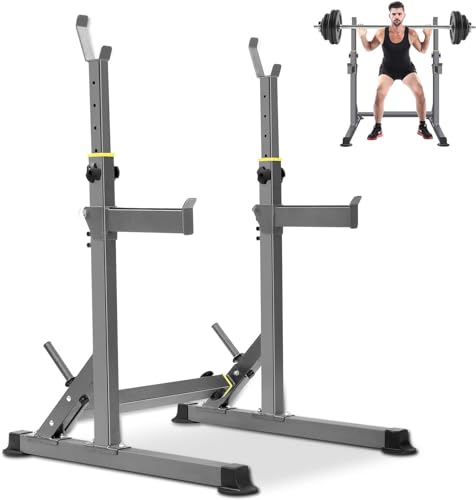
- Foldable design suits apartments and garages
- Adjustable width and height for varied setups
- Supports multiple barbell exercises
Best For: Compact home gyms needing a portable, adjustable rack
Best Overall Space-Saving System

- Folds to 4.3 sq. ft. for storage
- Combines rack and dual pulley training
- Offers five configurable workout modes
Best For: Small-space gyms seeking maximum versatility
Best Portable Pick
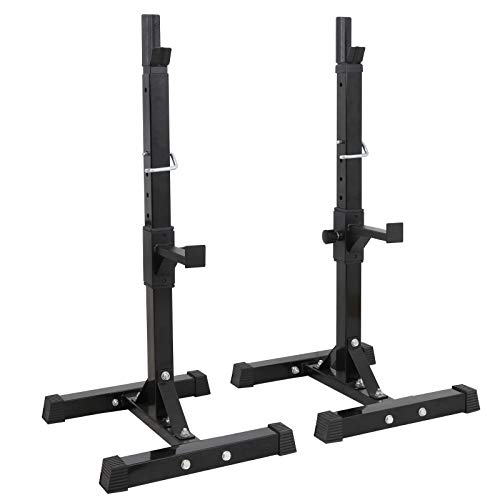
- Compact 17.7-by-20.1-inch footprint
- Adjusts from 40 to 66 inches
- Supports up to 550 pounds
Best For: Portable barbell training in compact home gyms
Best Full-Featured Cage

- Includes rack, pulley, crossover, and dip functions
- Offers 28 J-hook and spotter-arm positions
- Built-in storage helps reduce gym clutter
Best For: Dedicated home gyms with room for a tall cage
Best Adjustable Fit
K KiNGKANG Adjustable Squat Rack

- 13 height and 10 width settings
- 690-pound maximum capacity
- Includes storage racks and rubber feet
Best For: Flexible home-gym setups needing adjustable positioning
Best Fold-Away Design
Mdeam Folding Wall-Mounted Squat Rack
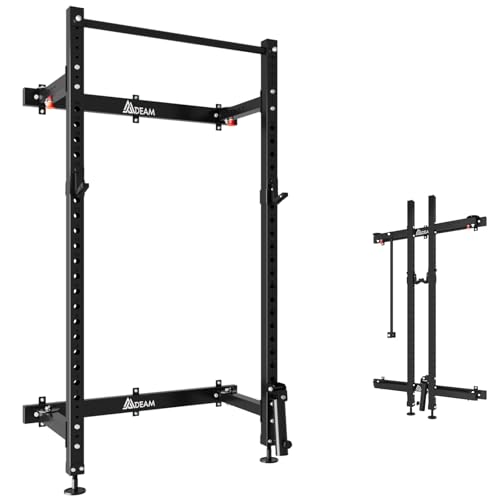
- Folds in about 15 seconds
- Supports up to 1,000 pounds
- Includes pull-up bar and landmine
Best For: Wall-mounted home gyms prioritizing saved floor space
Best Compact Freestanding Stand

- 600-pound maximum capacity
- Adjustable height and width
- H-shaped base with non-slip feet
Best For: Basic squat and bench-press training in a compact home gym
Best Wall-Mounted Pick – Mikolo Folding Wall-Mounted Squat Rack
For shoppers comparing squat racks for small spaces, the Mikolo stands out because it folds against the wall when not in use. Its 2-by-2-inch steel uprights, included stringer, pull-up bar, J-hooks, and safety catches create a versatile setup without requiring a permanent floor footprint.
Best For: Home gyms that have usable wall space but limited floor area.
Pros:
- Folds from a 19.7-inch projection to a 2-inch folded depth, according to the supplied dimensions.
- Supports up to 1,000 pounds and includes safety catches.
- Includes a pull-up bar, protected J-hooks, and a dual-size T-bar row attachment.
- Mounting hardware components and a stringer are included for installation.
Cons:
- Requires secure wall mounting and suitable installation space.
- It is less portable than a freestanding rack once installed.
The Mikolo is a strong space-saving choice when wall mounting is practical. Its folding design preserves room for other activities while still supporting squats, presses, rows, and pull-ups.
Best Adjustable Half Rack – FLYBIRD SR1 Adjustable Squat Rack
The FLYBIRD SR1 is a practical option for shoppers seeking squat racks for small spaces without giving up adjustability. Its compact footprint, adjustable width, numerous height settings, and extended safety arms make it suitable for several barbell movements in a home gym, garage, or basement.
Best For: Lifters who want a compact freestanding rack for 6-foot or 7-foot barbells.
Pros:
- Compact footprint is listed at 39 by 41.3 inches, with an 83-inch height.
- Offers 22 height adjustments and adjustable width for different barbell lengths.
- Supports up to 950 pounds with 2-by-2-inch commercial-grade steel.
- Includes 16.7-inch safety arms, a landmine attachment, band pegs, and a padded pull-up bar.
Cons:
- It may not be as easy to store as a folding or wall-mounted rack.
- The listed 83-inch height should be checked against low ceilings before purchase.
With a small footprint and broad adjustment range, the SR1 balances flexibility and space efficiency. It is especially useful when you need a freestanding rack that can accommodate different users and barbell sizes.
Best All-in-One Cage – ULTRA FUEGO Multi-Functional Power Rack
The ULTRA FUEGO power cage is aimed at shoppers who want squat racks for small spaces to serve as a complete training station. It combines a power cage with a pulley system, landmine, dip handles, storage pegs, and cable accessories, though its 63-inch depth requires more room than a basic rack.
Best For: Home gym owners who want multiple strength-training functions in one cage.
Pros:
- Combines a power cage, pulley system, lat pulldown bar, landmine, and dip handles.
- Includes six weight-plate storage pegs and four band pegs.
- Offers adjustable J-hook, safety-bar, and dip-handle positions.
- Rated in the supplied notes for up to 1,000 pounds and covered by a two-year warranty.
Cons:
- Its 63-inch depth may be too large for very tight rooms.
- At 82.7 inches tall, it may not suit low-ceiling spaces.
- The extensive accessory setup can require more assembly and planning than a basic rack.
This is the most feature-rich choice in the group, but it is not the smallest. Measure the full 63-by-47-by-82.7-inch footprint carefully before choosing it for a compact gym.
Best Portable Budget Option – K KiNGKANG Adjustable Foldable Squat Rack
The K KiNGKANG is a straightforward choice for shoppers comparing squat racks for small spaces, apartments, garages, and basements. Its foldable design, adjustable width, and height range make it easier to adapt to different users and store when training is finished.
Best For: Space-conscious beginners and home lifters who value portability and adjustability.
Pros:
- Foldable construction is designed for convenient storage in compact spaces.
- Width adjusts from 27.9 to 47.2 inches, while height adjusts from 33.85 to 64.9 inches.
- Supports squats, bench presses, shoulder presses, and other barbell exercises.
- Uses locking mechanisms and a steel frame for stability during training.
Cons:
- The supplied notes cite both a 600-pound maximum load and a 690-pound maximum-weight specification, so buyers should verify the applicable rating.
- The 180-day manufacturing-defect warranty is shorter than the warranties listed for several alternatives.
- Its lower maximum height may limit some taller users or overhead setups.
The KiNGKANG prioritizes storage and adjustability over the heavier construction and attachment selection of a full power cage. It is a sensible fit when a compact, foldable rack is more important than maximum capacity.
Best Overall Space-Saving System – WM3-V4 Folding Squat Rack
For shoppers comparing squat racks for small spaces, the WM3-V4 stands out by folding to 4.3 square feet for storage and expanding to 12.3 square feet when deployed. Its rack, pulley system, pull-up bar, and cable crossover functions are designed to provide broad training options in apartments, garages, or basements.
Best For: Small-space home gyms that want a versatile, all-in-one training station.
Pros:
- Folds for storage and offers five configurable training modes.
- Combines a power rack, dual independent pulleys, lat pulldown station, cable crossover, and pull-up bar.
- Provides 15 pulley-height adjustments and supports more than 80 listed exercises.
- Includes J-hooks, safety arms, quick-swap accessories, and a one-year warranty.
Cons:
- The two-box shipment and installation process may require planning.
- Its extensive cable and rack functionality may be more than needed for basic barbell training.
This is the most versatile option in the group for reclaiming floor space without giving up cable-based workouts. Confirm the wall-mounting requirements and available clearance before installation.
Best Portable Pick – F2C Adjustable Squat Rack
The F2C adjustable squat rack is a practical choice for squat racks for small spaces when portability and a compact footprint matter. Its two-stand design measures 17.7 by 20.1 inches and adjusts from roughly 40 to 66 inches, making it suitable for squats, bench presses, and other barbell exercises.
Best For: Home lifters who need a compact, movable rack for basic barbell training.
Pros:
- Compact footprint and portable 18.5-pound design.
- Supports up to 550 pounds and accommodates standard and Olympic barbells.
- Offers 13 safety-spotter positions for height adjustment.
- Rubber anti-skid pads help protect floors and reduce movement.
Cons:
- It is a pair of stands rather than an enclosed power cage.
- The connections should be fully tightened with a wrench for maximum security.
Choose this model if you want a straightforward rack that can be repositioned or stored more easily than a full cage. Its lower overall capacity and open-stand design make careful setup and appropriate loading important.
Best Full-Featured Cage – SunHome Power Cage
For shoppers considering squat racks for small spaces but still wanting a fuller home-gym setup, the SunHome Power Cage combines a rack, pulley system, cable crossover, dip handles, and storage. It measures 46.9 inches deep by 42.4 inches wide and stands 84.9 inches tall, so ceiling height and floor clearance deserve attention.
Best For: Strength-focused home gyms with room for a tall, multifunctional cage.
Pros:
- Supports squats, bench presses, pull-ups, dips, push-ups, and cable exercises.
- Provides 28 adjustable positions for J-hooks and spotter arms.
- Includes four weight-plate posts and two barbell storage hooks.
- Uses 2-by-2-inch steel tubing and lists a 1,500-pound power-cage capacity.
Cons:
- Its 84.9-inch height and 46.9-by-42.4-inch footprint require more dedicated space.
- At 115 pounds, it is less convenient to move than a portable stand.
- The supplied notes list differing maximum-capacity figures, so buyers should verify the applicable rating.
This cage delivers the broadest conventional rack setup of the three, especially for users who value integrated storage and adjustable safety positions. It is better suited to a dedicated corner than to extremely tight rooms.
Best Adjustable Fit – K KiNGKANG Adjustable Squat Rack
For shoppers comparing squat racks for small spaces, the K KiNGKANG stand offers a freestanding design with adjustable height and width. Its 13 height settings and 10 width settings make it easier to adapt the rack to your available training area and exercises.
Best For: Home users who want a versatile, freestanding rack with substantial load capacity.
Pros:
- Adjusts from 36.2 to 60 inches high and 29.9 to 46.3 inches wide.
- Supports up to 690 pounds with a thick carbon-steel frame.
- Includes rubber feet, two barbell storage racks, and removable trap-bar cylinders.
- Works for squats, presses, push-ups, and overhead lifts.
Cons:
- Its listed dimensions reach 46.4 inches wide and 79.9 inches high, so measure carefully before buying.
- As a freestanding rack, it does not offer the wall-mounted storage profile of a folding rack.
The broad adjustment range is the main advantage for a compact home gym, although the rack’s full footprint should be checked against your floor space. It is a practical choice when flexibility matters more than fold-away storage.
Best Fold-Away Design – Mdeam Folding Wall-Mounted Squat Rack
The Mdeam folding rack is a strong candidate for squat racks for small spaces because it mounts to the wall and folds for storage. It switches between its open and stored positions in about 15 seconds, helping reclaim floor area in a garage, basement, or home gym.
Best For: Space-conscious users who can mount a rack securely to a wall.
Pros:
- Folds from its training position to a listed folded size of 44×87 inches.
- 60×60 mm steel uprights support up to 1,000 pounds.
- Includes a pull-up bar, J-hooks, landmine, and stabilizer leveling feet.
- Supports squats, bench presses, pull-ups, rows, and deadlifts.
Cons:
- Requires wall mounting and suitable installation space.
- Its open dimensions are 44×25×87 inches, so it still needs adequate wall clearance.
- Installation is required, even though the product notes a 15–30 minute setup.
Among these options, the folding wall-mounted layout is the most directly focused on preserving floor space. Confirm the wall and surrounding clearance can accommodate the rack before installation.
Best Compact Freestanding Stand – CANPA Adjustable Squat Rack
For squat racks for small spaces, the CANPA adjustable stand provides a compact freestanding alternative to a full cage. Its adjustable height and width let you fit the stand to different users and bench-press positions while its H-shaped base helps keep it stable.
Best For: Home lifters who want a straightforward adjustable stand for squats and presses.
Pros:
- Adjusts from 50 to 57 inches high and 35.1 to 41.8 inches wide.
- Supports up to 600 pounds with a 2×2-inch heavy-duty steel frame.
- H-shaped base and non-slip foot covers help improve stability and protect floors.
- Includes two barbell storage racks and supports bench presses, squats, and overhead lifts.
Cons:
- It has only six height-adjustment levels.
- The listed maximum width is 41.8 inches, which may be wider than some very tight spaces.
- Nuts should be tightened with two wrenches rather than by hand.
The CANPA is a practical middle ground for a smaller gym that needs a stable stand without a full rack enclosure. Its dimensions are relatively manageable, but measure the available width and depth before placing it.
How We Picked the Best Squat Racks for Small Spaces
We focused on rack designs that suit apartments, garages, basements, and multipurpose rooms. Our comparison considers footprint, folding or adjustable construction, stated weight capacity, barbell compatibility, safety features, attachment options, and how much installation or assembly each style typically requires. Because manufacturer specifications can vary, verify the current capacity, dimensions, and included accessories before buying.
We also separated compactness from versatility. A folding rack may save the most space, while a power cage may provide better protection and more exercise options. Neither is automatically best for every lifter.
Quick Comparison
| Rack style | Best for | Main space advantage | What to check |
|---|---|---|---|
| Folding wall-mounted rack | Small rooms and garages | Folds close to the wall | Wall structure and folded depth |
| Adjustable squat stands | Portability and low cost | Minimal footprint | Base stability and independent stand spacing |
| Power cage | Frequent heavy training | One station supports many lifts | Interior dimensions and ceiling height |
| Rack with pulley system | Full-body training | Combines several stations | Cable travel, attachments, and overall depth |
Key Buying Factors for Squat Racks for Small Spaces
Available Floor and Wall Space
Measure the rack in both its training and stored positions. Leave room to unrack a bar, step back, load plates, and perform pull-ups or cable movements. A wall-mounted model needs a suitable structural surface and enough clearance to fold safely.
Stability and Safety
Look for a wide, weighted base or secure wall mounting, solid uprights, reliable J-hooks, and adjustable safety arms or spotter bars. A listed weight rating is useful, but it does not replace correct anchoring and level installation.
Barbell and Height Compatibility
Check whether the rack accommodates a standard or Olympic bar and whether its adjustment range works with your bar length, bench height, and ceiling. Shorter racks can be convenient in low-ceiling rooms but may limit pull-up space.
Storage and Attachments
Dip handles, pull-up bars, landmine mounts, pulley systems, and plate storage can increase value, but they also add depth and clearance requirements. Choose only features you expect to use regularly.
Who Should Buy Which Squat Racks for Small Spaces?
Choose a folding wall-mounted rack if reclaiming floor space is your top priority and you can anchor into suitable studs or masonry. These are especially practical for garages and shared rooms.
Choose adjustable squat stands if you need portability, simple setup, or a lower-cost way to squat and bench. They are convenient but generally require more attention to stance, balance, and storage.
Choose a power cage if you train alone, lift frequently, or want adjustable safety supports for squats and presses. Confirm that the cage fits your room before prioritizing extra attachments.
Choose a pulley-equipped rack if you want one compact station for strength and cable exercises. Measure its full operating area, not just the frame, and confirm that the included cable hardware meets your training needs.