Adding a slant board to a running routine can make calf stretching, ankle-mobility work, squats, and lower-leg recovery easier to perform consistently. The right board should feel stable underfoot while offering an incline that matches your flexibility and training needs.
We compared 10 adjustable and fixed-style options across construction, angle range, grip, portability, and stated weight capacity to help you choose a practical fit for home workouts, warmups, and recovery sessions.
Best 10 Slant Board for Runners Picks for 2026
Best Overall Wooden Pick
StrongTek Adjustable Slant Board

- Five incline settings from 15° to 35°
- Full-coverage anti-slip surface
- Hardwood plywood with carry handle
Best For: Runners seeking a sturdy, versatile wooden stretching board
Best Heavy-Duty Option

- Steel construction with 600-lb capacity
- Five angles from 15° to 40°
- Sandpaper top and four rubber feet
Best For: Runners who prioritize load capacity and stability
Best Portable Wide Board
StrongTek Foldable Slant Board

- 13-inch wide platform for natural stance
- Folds flat with an integrated handle
- Five settings from 15° to 35°
Best For: Runners wanting a roomy, portable mobility board
Best With Exercise Guide
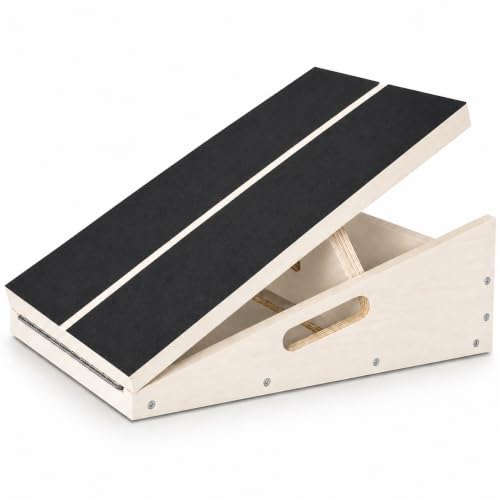
- Five angles from 15° to 35°
- 500-lb stated capacity
- Includes guide and three-year warranty
Best For: Runners wanting guided, adjustable calf mobility work
Portable Recovery Pick
Adjustable Wooden Calf Stretcher

- Four angle settings from 30° to 45°
- Lightweight at about 4.5 pounds
- Designed for stretching, squats, and recovery
Best For: Runners seeking a portable, multi-purpose stretching board
Training Flexibility Pick
Five-Angle Portable Stretch Board

- Five angles from 23° to 45°
- Folds for easier transport
- Includes workout poster and instructions
Best For: Runners wanting progressive stretching intensity and guidance
High-Capacity Stability Pick

- Textured surface with non-slip EVA base
- Five angles from 23° to 45°
- Includes guide and lists a one-year warranty
Best For: Runners prioritizing traction, portability, and varied mobility exercises
Best Beginner-Friendly Pick

- Four settings from 15° to 30°
- Reinforced screw construction
- 250-pound capacity
Best For: Beginners and runners wanting gradual post-run stretching
Best Portable High-Capacity Pick
TEMI Wooden Calf-Stretching Wedge

- Built-in handle and portable size
- Four angles from 20° to 40°
- 500-pound stated capacity
Best For: Mobile runners and athletes training calves, ankles, and squats
Best Versatile Balance Pick

- Seven angles from 18° to 40°
- Combines stretching and balance training
- 300-pound capacity with anti-slip surface
Best For: Runners wanting stretching, mobility, and balance functions in one tool
Best Overall Wooden Pick – StrongTek Adjustable Slant Board
If you want a dependable slant board for runners, this StrongTek model combines five incline settings with a full-coverage non-slip surface. Its wooden construction, side handle, and calf-focused design make it practical for warm-ups, cooldowns, mobility work, and recovery routines.
Best For: Runners who want a sturdy, portable wooden board for calf and ankle stretching at home, in the gym, or while traveling.
Pros:
- Five adjustable positions from 15° to 35° support progressive stretching.
- Anti-slip safety treads help provide secure foot placement.
- High-quality Lauan hardwood plywood and an integrated side handle support durability and portability.
- Suitable for calf stretching, squats, rehab, and recovery work.
Cons:
- At 9 pounds, it is heavier than some portable alternatives.
- The wood construction may take more storage space than a folding design.
This is a well-rounded choice when stability and a broad range of uses matter more than ultralight portability. The five positions also make it easier to adjust intensity as your mobility changes.
Best Heavy-Duty Option – Steel 600-Lb Slant Board
For runners who prefer a reinforced platform, this steel slant board for runners offers five angle settings and a stated 600-pound weight capacity. Its sandpaper-style top and four rubber feet are designed to improve traction and stability during stretching, squats, and mobility exercises.
Best For: Users prioritizing a high weight rating and stable steel construction for demanding workouts or physical-therapy exercises.
Pros:
- Steel construction is designed to resist cracking and remain sturdy under load.
- Five settings range from 15° to 40° for varied stretching angles.
- Non-slip sandpaper surface increases friction during use.
- Four rubber feet help stabilize the board and protect flooring.
Cons:
- Its 4.91-kilogram weight may be less convenient to carry.
- The steel design may feel less comfortable or warm than wood for some users.
This model stands out for runners who want maximum rated capacity and a firmly planted training surface. It is a practical fit for controlled lower-body work where portability is secondary.
Best Portable Wide Board – StrongTek Foldable Slant Board
This wide StrongTek board is a useful slant board for runners who want adjustable mobility work without a cramped stance. Its 13-inch platform, five settings, foldable body, and carry handle support calf stretching, squats, lunges, and travel-friendly storage.
Best For: Runners who need a wider platform and a foldable design for home gyms, clinics, or on-the-go training.
Pros:
- Extra-wide 13-inch platform allows more natural foot placement.
- Five angles from 15° to 35° support gradual progression.
- High-grip top and rubber anti-slip pads help secure the board and protect floors.
- Foldable design and integrated handle simplify storage and transport.
Cons:
- Its 350-pound maximum recommended load is lower than some heavy-duty options.
- The folding hinges add components that may require care over long-term use.
Choose this version if stance space and portability are priorities. At 5.3 pounds, it balances a substantial 350-pound rating with a more travel-friendly form than many fixed boards.
Best With Exercise Guide – Wooden 500-Lb Calf Board
This wooden slant board for runners offers five adjustable angles, a textured top, and a slip-resistant base for calf stretching and ankle-mobility routines. An included visual exercise guide, side handles, and a three-year warranty add practical support for regular home or gym use.
Best For: Runners who want a traditional wooden calf board with exercise ideas, a high stated capacity, and easy carrying.
Pros:
- Five settings from 15° to 35° allow gradual intensity changes.
- Reinforced plywood supports a stated 500-pound capacity.
- Textured standing surface and slip-resistant base help improve stability.
- Includes a visual exercise guide, side handles, and a three-year warranty.
Cons:
- It weighs about 3.85 kilograms, so it is not the lightest option.
- The listed 16-by-12.5-inch size may be less roomy than a wider board.
This board is a strong fit for runners building a repeatable stretching routine, especially beginners who may appreciate the included exercise guidance. Its capacity and warranty also make it suitable for consistent use beyond simple calf stretches.
Portable Recovery Pick – Adjustable Wooden Calf Stretcher
For runners comparing a slant board for runners, this lightweight wooden model offers four incline settings for calf stretching, squats, and lower-leg mobility. Its compact design makes it practical for home, office, gym, or clinic use.
Best For: Runners who want a portable, straightforward board for stretching and rehabilitation routines.
Pros:
- Four adjustable angles: 30°, 35°, 40°, and 45°.
- Lightweight design at about 4.5 pounds.
- Suitable for calf, ankle, heel, leg, and squat exercises.
- Can support flexibility, mobility, and recovery-focused routines.
Cons:
- Offers fewer angle settings than some comparable boards.
- The supplied details do not specify a maximum weight capacity.
- Its listed dimensions may be less convenient for larger foot placements.
This is a versatile choice if portability and simple angle adjustment matter most. It is especially useful for runners building regular stretching into warm-ups, cooldowns, or recovery sessions.
Training Flexibility Pick – Five-Angle Portable Stretch Board
This slant board for runners provides five incline choices, letting users progress from a gentler 23° position to a more demanding 45° stretch. It folds for transport and includes a workout poster and instructions for getting started.
Best For: Runners who want multiple intensity levels and simple guidance for calf and lower-leg exercises.
Pros:
- Five adjustable angles: 23°, 30°, 35°, 40°, and 45°.
- Folding, portable design weighs about 4.6 pounds.
- Supports calf, glute, heel, ankle, and leg stretching.
- Includes a training poster and instructions.
Cons:
- The supplied information lists both a 460-pound capacity highlight and a 300-pound maximum recommendation, so shoppers should verify the applicable limit.
- No warranty is listed in the product details.
- It may offer less traction-specific information than boards with an explicitly described textured surface.
With its broad angle range and included training materials, this board suits runners who want to adjust stretching difficulty over time. Its folding construction is also useful for taking mobility work between home and the gym.
High-Capacity Stability Pick – Textured Wooden Incline Board
For runners who prioritize traction and a high stated capacity, this slant board for runners uses a textured PVC sandpaper surface and non-slip EVA base. Five angle settings support calf stretching, warm-ups, cooldowns, squats, and mobility work.
Best For: Runners seeking a stable, portable board with traction-focused construction and a wide angle range.
Pros:
- Textured top surface and non-slip EVA base are designed to improve traction.
- Five adjustable angles from 23° to 45°.
- Lightweight construction weighs about 4.5 pounds.
- Includes a training poster and instruction guide, with a one-year warranty listed.
Cons:
- The supplied details list a 460-pound support claim but a 300-pound maximum recommendation, creating a capacity discrepancy.
- The textured surface may feel more abrasive than a smoother board for some users.
- Users must unfold the support panel and confirm stability before exercising.
This model stands out for its traction-oriented surface and portability. It is a strong option for runners who want one board for stretching, heel-elevated squat variations, and post-run mobility, provided they confirm the applicable weight limit.
Best Beginner-Friendly Pick – Reinforced Wood Slant Board
For runners seeking a slant board for runners that supports gradual calf and lower-leg stretching, this reinforced wood model offers four manageable incline settings from 15° to 30°. Its adjustable design suits post-run mobility work, flexibility training, and gentle rehabilitation routines.
Best For: Beginners, seniors, runners, and rehabilitation users who want a progressive calf, Achilles, plantar fascia, hamstring, or lower-back stretch.
Pros:
- Starts at a relatively gentle 15° angle and increases in four smooth steps.
- Reinforced with longer, stronger screws to support hinge and adjustment-bracket durability.
- Supports up to 250 pounds and can be used at home, under a desk, in a gym, or in physical therapy settings.
- Targets several lower-body areas, including calves, Achilles tendons, plantar fascia, and hamstrings.
Cons:
- Offers a maximum incline of 30°, which may be less challenging than steeper models.
- The notes do not mention a built-in handle or dedicated carrying feature.
Its low starting angle and reinforced construction make it a practical choice for runners prioritizing controlled stretching and everyday durability over advanced incline range.
Best Portable High-Capacity Pick – TEMI Wooden Calf-Stretching Wedge
This TEMI wedge is a portable slant board for runners who want calf stretching, ankle mobility, and squat-position training across different locations. It weighs about 5 pounds, includes a built-in handle, and provides four incline options from 20° to 40°.
Best For: Runners, athletes, and rehab users who value portability, a high weight capacity, and multiple incline choices for calf, heel, ankle, and squat work.
Pros:
- Built-in handle and compact dimensions make it convenient for home, office, gym, or travel use.
- Supports up to 500 pounds according to the supplied notes.
- Provides 20°, 25°, 30°, and 40° wedge positions for varied mobility and squat training.
- Uses a wooden base with a soft non-slip surface for stability during stretches and drills.
Cons:
- Its lowest setting is 20°, so it may feel less gentle than a board starting at 15°.
- It uses fixed wedge positions rather than a continuously adjustable incline.
Choose this model if carrying convenience and a broad, higher-capacity incline range matter more than the gentlest entry angle or fine-grained adjustments.
Best Versatile Balance Pick – 3-in-1 Wooden Slant Board
Runners looking for a multifunctional slant board for runners may prefer this 3-in-1 design, which combines incline stretching, a slant platform, and balance training. Seven settings from 18° to 40° let you adjust the challenge for calf stretching, ankle mobility, squats, and balance exercises.
Best For: Runners and fitness users who want one compact wooden tool for stretching, balance work, physical therapy exercises, and progressive mobility training.
Pros:
- Offers seven incline angles ranging from 18° to 40° for more adjustment options.
- Functions as a slant board, stretching platform, and balance board.
- Includes an anti-slip surface designed to support stability during barefoot exercises.
- Supports up to 300 pounds and uses a durable pine-wood construction.
Cons:
- Balance mode requires placing the curved base underneath and removing it for slant-board use.
- At 3.07 kg, it is heavier than the TEMI model described in the supplied notes.
- The notes describe assembly or setup steps for switching to balance mode.
This is the strongest fit for buyers who want more than a basic calf stretcher, especially if balance training and adjustable progression are part of the running routine.
How We Picked the Best Slant Board for Runners
We focused on features that matter during repeated stretching and mobility work: a secure non-slip surface, a stable base, useful incline adjustments, durable construction, and a size that accommodates typical foot placement. Weight capacity was also considered, but published ratings should be treated as guidance rather than a substitute for careful, controlled use.
Because runners may use a board for both gentle mobility and loaded movements such as squats, we favored products that clearly describe their angle settings and construction. Portability, handles, and storage-friendly designs received extra attention for runners who train in different locations.
Quick Comparison
- Best for adjustability: Choose a model with several clearly defined angles, especially if you are progressing gradually.
- Best for stability: Look for a broad platform, reinforced wood or steel construction, and a high-traction surface.
- Best for portability: Select a lighter wooden board or one with side handles.
- Best for demanding use: Consider a sturdy steel or reinforced design with a clearly stated weight rating.
- Best for varied workouts: A board with multiple incline positions can support calf stretching, ankle mobility, squats, and balance drills.
Key Buying Factors for a Slant Board for Runners
Incline Range
A lower angle is generally easier for tight calves or early mobility work, while steeper settings create a stronger stretch. Adjustable models are more versatile, but the angle markings should be easy to understand and the adjustment mechanism should lock securely.
Surface Grip and Stability
Traction is essential because the board transfers force through your feet and calves. Look for a textured, rubberized, or velour-covered surface paired with non-slip feet or a stable base. Use the board on a level, dry floor and stop if it shifts.
Size, Capacity, and Construction
Check the platform width and length against your shoe size and preferred stance. Wood is often lightweight and convenient, while steel may offer greater rigidity. A higher stated capacity can be reassuring, but it does not automatically mean the board is safer or more comfortable.
Portability and Storage
Handles, compact dimensions, and low weight are useful if you move between home, the gym, and the track. If the board will stay in one place, prioritize stability and surface comfort over carrying features.
Who Should Buy Which Slant Board for Runners?
New users and runners with limited flexibility should start with an adjustable board that includes gentler angles. Experienced runners may prefer a wider range of steeper settings for progressive stretching and mobility drills. Runners who combine stretching with strength work should prioritize a rigid, high-capacity design with strong traction. Traveling or space-conscious users will benefit from a lightweight board with handles and a compact profile.
A slant board can support a consistent mobility routine, but it should complement—not replace—professional evaluation for persistent pain or injury. Begin with a comfortable angle, keep movements controlled, and follow the manufacturer’s weight and usage instructions.