A low ceiling should not prevent you from building a capable home gym. The best power racks for low ceilings provide enough clearance for squats, presses, pull-ups, and safety adjustments without wasting valuable floor space.
We selected compact and folding designs across several price points, including short standalone racks, wall-mounted frames, and models with pulley systems. Use the guide below to match rack height, depth, capacity, and installation requirements to your training space.
Best 10 Power Rack for Low Ceilings Picks for 2026
Best Low-Profile Pick
Titan Fitness T-2 Series Short Power Rack
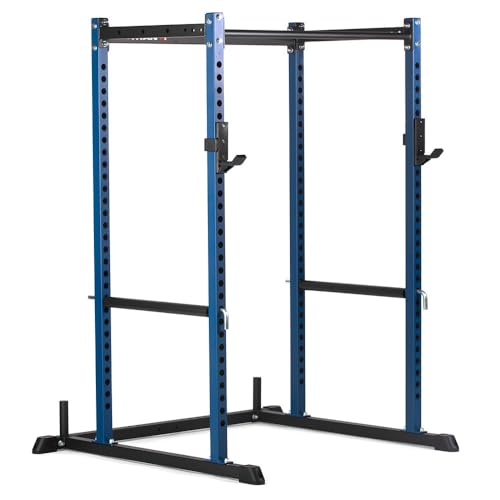
- 71-inch height option for low ceilings
- 850-pound rackable capacity
- Includes J-hooks and pin-and-pipe safeties
Best For: Compact home and garage gyms
Best Folding Cable System

- Folds to save floor space
- Includes a 1:1 dual pulley system
- Combines rack, pulleys, pull-up bar, and landmine
Best For: Compact multifunction home gyms
Best Full-Size Option
Sunny Health & Fitness Power Rack

- 18-point J-hook adjustment
- Includes spotter arms and plate storage
- Listed height is 87 inches
Best For: Full-size home gyms with higher ceilings
Best Wall-Mounted Value
Mikolo Folding Wall Mounted Squat Rack

- Folds to a 2-inch storage depth
- 1,000-pound stated capacity
- Includes pull-up, safety, and row attachments
Best For: Wall-mounted gyms needing compact storage
Best Compact Freestanding Pick

- 85.43-inch overall height
- 500-pound capacity
- Integrated pull-up and storage features
Best For: Home and garage gyms needing a lower-profile freestanding rack
Best Wall-Mounted Space Saver
Titan Fitness X-3 Folding Rack

- Folds to 8 inches from the wall
- 1,000-pound weight capacity
- Includes adjustable pull-up bar and J-hooks
Best For: Wall-mounted gyms focused on floor-space efficiency
Best Adjustable Budget-Size Rack

- 81.9-inch overall height
- 660-pound stated capacity
- Adjustable barbell shelves
Best For: Lower-ceiling home gyms needing a shorter adjustable rack
Best Low-Ceiling Wall Rack

- 82-inch height for limited-clearance rooms
- Wall-mounted 24-inch-deep design
- Includes J-hooks and pull-up bar
Best For: Compact home gyms focused on barbell training
Best Full-Featured Cage Under 83 Inches

- 82.6-inch cage height
- Integrated pulley and lat pulldown system
- Includes storage and many attachments
Best For: Multi-user home gyms needing varied exercises
Best Folding Cable Rack

- Folds to 4.3 square feet
- Five rack and cable configurations
- Dual independent pulley system
Best For: Small rooms requiring fold-away training equipment
Best Low-Profile Pick – Titan Fitness T-2 Series Short Power Rack
For shoppers looking for a power rack for low ceilings, the Titan Fitness T-2 Series is notable for its 71-inch height option. It uses 14-gauge, 2-by-2-inch steel uprights, includes J-hooks, and adds pin-and-pipe safeties for solo barbell training.
Best For: Home and garage gyms with limited overhead clearance that still need a traditional power rack.
Pros:
- Available in a compact 71-inch height, as well as an 83-inch option.
- Includes J-hooks rated for up to 1,000 pounds.
- Pin-and-pipe safeties provide a catch point for failed lifts.
- Rackable capacity is listed at 850 pounds, with total rack capacity up to 2,200 pounds.
Cons:
- The included pull-up bar is a single, skinny 1.25-inch design rather than a multi-grip bar.
- The 71-inch height may limit pull-up range for taller users.
Choose the 71-inch version when ceiling clearance is the priority. Its strong capacity ratings and included safety equipment make it a practical low-height option for foundational barbell work.
Best Folding Cable System – Mdeam Folding Squat Rack
The Mdeam Folding Squat Rack combines wall-mounted storage with a dual pulley system, making it a versatile choice when floor space and ceiling height are both concerns. Its seven adjustable angles allow the rack to fold away after use.
Best For: Small basements, garages, or shared home gyms that want cable training and a fold-away rack.
Pros:
- Folding design helps conserve floor space after workouts.
- Dual pulley system uses a 1:1 ratio for independent crossover movements.
- Combines a rack, cable crossover, lat pulldown, pull-up bar, and 360-degree landmine.
- Uses 2-by-2-inch, 14-gauge steel and is rated to handle up to 1,000 pounds.
Cons:
- As a wall-mounted unit, it requires a suitable wall installation.
- The supplied notes do not state the rack’s overall height, so ceiling clearance should be verified before purchase.
This is more than a basic squat rack, but its multifunction design may justify the installation work for users who want several training stations in a compact setup. Confirm the dimensions and mounting location before ordering.
Best Full-Size Option – Sunny Health & Fitness Power Rack
The Sunny Health & Fitness Full Size Power Rack supports squats, presses, pull-ups, and band work in one steel frame. It offers 18-point J-hook adjustment, safety spotter arms, and built-in plate storage, though its listed 87-inch height may not suit every power rack for low ceilings setup.
Best For: Users with adequate ceiling clearance who want an adjustable rack that can expand with compatible attachments.
Pros:
- 18-point J-hook adjustment supports varied squat and press setups.
- Includes safety lock spotter arms for barbell training.
- Built-in plate holders keep Olympic plates close to the rack.
- Angled pull-up bar has eight positions and the rack supports compatible attachments.
Cons:
- The listed 87-inch height makes it less suitable for genuinely low ceilings.
- Attachments are sold separately.
- Listed capacities are 300 pounds for the pull-up bar, J-hooks, and spotter arms.
This rack is a capable full-size choice, but height is the key screening factor. Measure your ceiling and account for lifting clearance before choosing it for a low-ceiling room.
Best Wall-Mounted Value – Mikolo Folding Wall Mounted Squat Rack
The Mikolo Folding Wall Mounted Squat Rack is designed for compact training areas, with a folding depth that helps keep the floor clear. Its listed 85.8-inch height means it may work for some restricted spaces, but buyers should measure carefully when shopping for a power rack for low ceilings.
Best For: Wall-mounted home gyms that want a fold-away rack with pull-up and row-training accessories.
Pros:
- Folds from a 19.7-inch open depth to a 2-inch folded depth.
- Uses 2-by-2-inch, 13-gauge steel and is rated for up to 1,000 pounds.
- Includes a quick-attach pull-up bar, J-cups with UHMW inserts, and safety catches.
- Includes a 360-degree dual-size T-bar row attachment.
Cons:
- The listed 85.8-inch height may be too tall for very low ceilings.
- Wall mounting is required, so the installation surface must be suitable.
- Its compact folded depth does not reduce the stated overall height.
The Mikolo is a strong space-saving candidate when your ceiling can accommodate its height. Its folding mechanism and included accessories provide useful versatility without taking up much stored floor space.
Best Compact Freestanding Pick – CAP FM-905Q Power Rack
The CAP FM-905Q is a practical power rack for low ceilings, measuring 85.43 inches high. Its open frame supports squats, presses, pull-ups, and other home-gym exercises while built-in storage helps keep the training area organized.
Best For: Home and garage gym users who want a freestanding rack with integrated pull-up and storage features.
Pros:
- 85.43-inch height suits many lower-ceiling spaces.
- 500-pound capacity supports a range of barbell and bodyweight exercises.
- Integrated pull-up bar and bar-and-weight storage add versatility.
Cons:
- Its 50.79-inch width and 45.67-inch depth require a dedicated floor area.
- Includes a 30-day limited manufacturer warranty.
With its relatively low profile and open-frame layout, the FM-905Q is a straightforward choice when you need a freestanding rack without adding a separate pull-up station.
Best Wall-Mounted Space Saver – Titan Fitness X-3 Folding Rack
The Titan Fitness X-3 is a wall-mounted folding power rack for low ceilings and tight training areas. Its folding design stores to within 8 inches of the wall, while the 91-inch model provides a substantial height option for users who can accommodate it.
Best For: Wall-mounted home or garage gyms that prioritize floor-space savings and a high weight capacity.
Pros:
- Folds close to the wall to help preserve usable floor space.
- Rated for a 1,000-pound weight capacity.
- Includes adjustable pull-up bar, standard J-hooks, and Westside hole spacing.
Cons:
- The supplied product title identifies a 91-inch model, so ceiling clearance should be measured carefully.
- Wall-mounting hardware is not included; supplied hardware is for assembly only.
- Titan recommends two-person assembly.
This rack is especially useful when a permanent wall installation is acceptable. Confirm both ceiling height and suitable mounting conditions before buying.
Best Adjustable Budget-Size Rack – Bongkim Adjustable Power Rack
The Bongkim Power Rack measures 81.9 inches high, making it a strong candidate for a power rack for low ceilings. Its alloy-steel frame supports squats, deadlifts, pull-ups, and barbell training, with adjustable shelves and a spindle link for positioning flexibility.
Best For: Home-gym users who need a compact, adjustable rack with a 660-pound stated capacity.
Pros:
- 81.9-inch height is the shortest listed option in this roundup.
- 660-pound maximum weight capacity.
- Adjustable front and rear barbell shelves accommodate different user heights.
- Includes assembly hardware, tools, and a user manual.
Cons:
- Its 47.6-inch depth and 43.3-inch width still require dedicated floor space.
- The product notes do not specify an included warranty term beyond a one-year warranty description.
The Bongkim stands out for ceiling clearance and adjustability. It is a sensible option when a shorter rack footprint matters, provided its dimensions fit your available workout area.
Best Low-Ceiling Wall Rack – Titan T-3 Space Saving Rack
If you need a power rack for low ceilings, the Titan T-3 is a compact wall-mounted option with an 82-inch height and 24-inch depth. Its space-efficient design preserves core rack functionality while reducing the footprint compared with a conventional cage.
Best For: Home gym users who want a compact, wall-mounted rack for squats, bench work, pull-ups, and heavy barbell training.
Pros:
- 82-inch height suits many rooms with limited overhead clearance.
- Wall-mounted 24-inch depth helps conserve floor space.
- Includes reinforced J-hooks and a 1.25-inch pull-up bar.
- J-hooks are rated for loads up to 1,000 pounds.
Cons:
- Wall mounting hardware is not included.
- Optional side braces are needed to secure the lower portion for added stability.
- Two-person assembly is recommended.
The T-3 is one of the more straightforward choices when ceiling height and floor space are both concerns. Plan the wall installation carefully, especially if you intend to use the rack with heavy loads.
Best Full-Featured Cage Under 83 Inches – Sportsroyals Power Rack
For shoppers seeking a power rack for low ceilings, the Sportsroyals cage stands 82.6 inches tall while combining a rack, pulley system, lat pulldown, dip station, and storage features. Its 61.6-by-56-inch footprint is larger than a wall-mounted rack, but it offers substantially more training functionality.
Best For: Families or home gym users who want a multi-exercise power cage with cable training and built-in equipment storage.
Pros:
- 82.6-inch height can work in rooms with modest ceiling clearance.
- Includes upper and lower pulley systems for rows and pulldowns.
- Offers 14 adjustable height levels and numerous included attachments.
- Built-in holders organize barbells, plates, and handles.
Cons:
- Its 61.6-by-56-inch footprint requires more floor space than a compact wall rack.
- Assembly is recommended for two to three people.
- The rack ships in two boxes that may arrive separately.
This is a strong choice if versatility matters more than minimal footprint. Before buying, measure both the ceiling and available floor area, then allow room for pulley exercises and access around the cage.
Best Folding Cable Rack – WM3-V4 Folding Squat Rack
The WM3-V4 is a practical power rack for low ceilings and tight rooms because it folds down to 4.3 square feet for storage and expands to 12.3 square feet when deployed. It combines a squat rack with dual independent pulleys, a pull-up bar, and multiple setup modes for flexible training.
Best For: Apartment, garage, or basement users who need a versatile rack that can be folded away between workouts.
Pros:
- Folds to a compact 4.3-square-foot storage area.
- Provides five configurations, including half-rack and cable-crossover modes.
- Dual independent 1:1 pulley system supports simultaneous cable exercises.
- Offers 15 pulley height adjustments and included J-hooks and safety arms.
Cons:
- Wall installation and setup still require careful planning.
- Its maximum weight recommendation and cable capacity claims should be checked against your intended training setup.
- Only a one-year warranty is specified in the supplied details.
The folding design makes this the most storage-friendly option of the three. It is especially appealing when you need cable versatility but cannot leave a full rack permanently open, though the available wall structure and clearance should be confirmed before installation.
How We Picked the Best Power Rack for Low Ceilings
We focused on racks that are practical for rooms with restricted vertical clearance, such as garages, basements, spare bedrooms, and apartment gyms. The selection includes short frames, folding wall-mounted racks, and compact models that reduce the space needed behind or around the uprights.
We also considered construction, stated weight capacity, safety hardware, pull-up clearance, adjustment options, attachments, and the type of training each rack supports. Because low-ceiling spaces vary significantly, measurements and installation requirements should always be verified before ordering.
Quick Comparison
| Rack type | Best for | Main advantage | Important consideration |
|---|---|---|---|
| Short standalone rack | Renters or flexible layouts | Simple setup and repositioning | Usually uses more floor space |
| Folding wall rack | Small rooms and garages | Folds toward the wall when unused | Requires secure wall mounting |
| Rack with pulley system | Full-body cable training | Combines barbell and pulley exercises | Needs additional clearance and setup space |
| Heavy-duty compact rack | Frequent heavy lifting | Greater stability and durability | Often costs more and weighs more |
Key Buying Factors for a Power Rack for Low Ceilings
Height and Overhead Clearance
Measure from the floor to the lowest ceiling obstruction, including beams, lights, garage-door tracks, and ductwork. Leave enough room to load the bar, adjust the J-hooks and safeties, and perform movements without contacting the ceiling. A pull-up bar can be the limiting feature even when the rack frame fits.
Depth, Folding Clearance, and Wall Structure
Check both the rack’s operating depth and its folded depth. Wall-mounted models save floor space only when they are anchored to suitable studs or masonry. Confirm that the wall can support the rack, user movement, and loaded barbell, and allow room to walk around the frame safely.
Steel, Capacity, and Safety Hardware
Look at upright dimensions, steel gauge, hole spacing, J-hook design, and the included safety pins or spotter arms. Stated capacity is useful for comparison, but stability also depends on anchoring, rack width, flooring, and whether the design is bolted down.
Training Features and Compatibility
Choose a basic rack if you mainly squat, bench, and press. Pulley systems and lat attachments add exercise variety but require more assembly, cable clearance, and maintenance. Also check whether the rack accepts standard or Olympic bars and whether compatible accessories are included or sold separately.
Who Should Buy Which Power Rack for Low Ceilings?
Choose a short standalone rack if you need a straightforward setup that can be moved or used without permanent wall installation. These models suit renters and multipurpose rooms.
Choose a folding wall-mounted rack if floor space is the main constraint and you can install it securely. It is particularly useful in garages or rooms that must serve multiple purposes.
Choose a pulley-equipped rack if you want cable rows, pulldowns, and accessory exercises alongside barbell training. Make sure the ceiling and surrounding area provide enough room for cable movement.
Choose a heavier-duty compact rack if you train frequently, lift substantial loads, or want a more rigid long-term setup. Prioritize steel construction, dependable safeties, and proper anchoring over extra attachments.