A Pilates chair can add challenging resistance, balance work, and compact strength training to a home routine. Models with adjustable footbars offer more flexibility than fixed designs, helping accommodate different exercises, body sizes, and experience levels.
We compared 10 popular Pilates chairs with adjustable footbars, focusing on construction, pedal and handle design, resistance options, comfort, portability, and setup. Use the guide below to narrow your choices before buying.
Best 10 Pilates Chairs with Adjustable Footbars Picks for 2026
Versatile Maple Stability
EchoMe Split-Pedal Combo Chair

- Adjustable split-pedal width and angle
- Two springs per pedal for varied resistance
- Three-height removable handles
Best For: Customizable home or studio Pilates workouts
Space-Saving Home Training

- Four resistance levels for varied workouts
- Five-level adjustable support bars
- Upright storage and 330-pound capacity
Best For: Home and apartment users seeking versatile training
Oak Studio Style
Adjustable-Handle Stability Combo Chair

- Oak frame with PU-leather upholstery
- Split pedals and high-strength springs
- Knob-adjustable handles
Best For: Home, gym, or studio users prioritizing finish and comfort
Sturdy Four-Position Frame
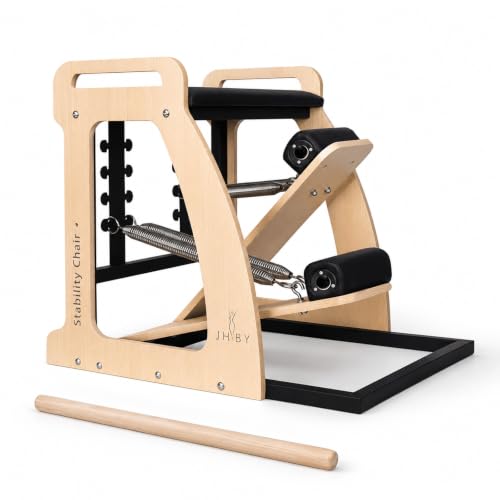
- Four spring positions for resistance changes
- Wood-and-metal frame with padded surfaces
- Detachable design for home setup
Best For: Home users wanting stable, adjustable resistance training
Compact Resistance Pick
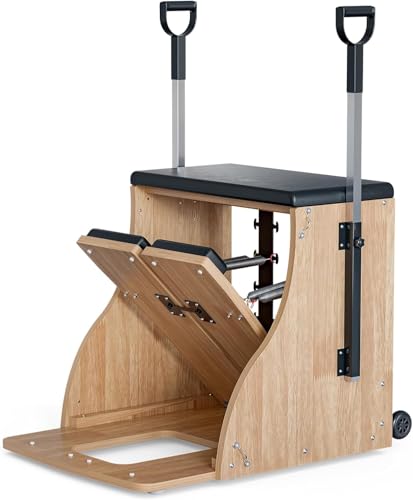
- Four adjustable spring positions
- Split pedals for balance training
- Supports up to 400 pounds
Best For: Compact home workouts and rehabilitation
Premium Oak Option
Holymuss Adjustable Pilates Chair

- Solid oak frame supports 380 pounds
- Four-position, color-coded spring system
- Three-height handles and included bands
Best For: Versatile home, studio, and gym workouts
Rehabilitation-Friendly Choice

- Four adjustable spring resistance levels
- Four-height adjustable handles
- 400-pound capacity in a compact frame
Best For: Controlled home Pilates and recovery routines
Compact Split-Pedal Pick
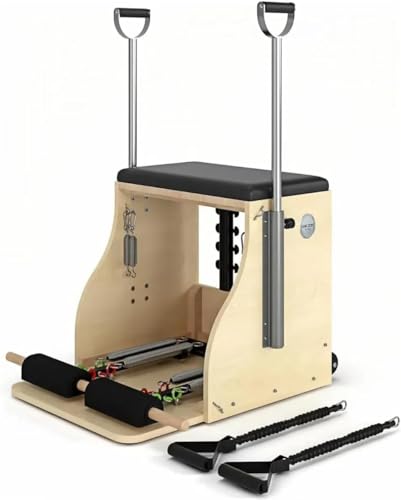
- Adjustable split-pedal width and angle
- Compact home-friendly footprint
- 330-pound maximum weight recommendation
Best For: Home users prioritizing pedal adjustability and space efficiency
Best Heavy-Duty Pick

- Five handle-height adjustments
- Four spring positions and band hooks
- Casters support easier relocation
Best For: Seniors and rehabilitation-focused home workouts
Heavy-Duty Oak Option

- Oak frame supports up to 351 pounds
- Four spring positions with two resistance levels
- Three handle heights and included bands
Best For: Home or studio users wanting a sturdy, adjustable chair
Versatile Maple Stability – EchoMe Split-Pedal Combo Chair
For shoppers comparing pilates chairs with adjustable footbars, the EchoMe Combo Chair stands out for its split pedals, removable handles, and multiple resistance options. Its maple-wood construction and compact footprint make it suitable for targeted home or studio training.
Best For: Users who want customizable split-pedal workouts, adjustable handles, and a broad range of spring resistance.
Pros:
- Split pedals offer adjustable width and angle for personalized positioning.
- Includes two springs per pedal, with red heavy and green light resistance options.
- Handles adjust to three heights and can be removed when needed.
- Installation is designed to take about 30 minutes and includes customer support.
Cons:
- At 68 pounds, it may be cumbersome to move frequently.
- The supplied details do not specify adjustable footbar terminology, so verify the pedal and handle setup meets your needs.
With a 350-pound maximum weight recommendation and a one-year warranty, this is a feature-rich option for buyers prioritizing adjustability and stability over lightweight portability.
Space-Saving Home Training – AddWin Adjustable Wunda Chair
The AddWin Wunda Chair is a practical choice for shoppers seeking pilates chairs with adjustable footbars and a compact home setup. It combines split pedals, adjustable support bars, four resistance levels, and a cushioned seat for full-body training.
Best For: Home users who want adjustable support bars, durable springs, and a chair that can be stored upright.
Pros:
- Offers four resistance levels, from soft to pro, for controlled progression.
- Support bars adjust across five levels to help vary exercises.
- Solid wood frame and metal components support up to 330 pounds.
- Includes a 2-year frame warranty and a 1-year warranty for moving parts and upholstery.
Cons:
- Its 50.39-inch listed height may require more vertical storage space than compact chairs.
- At 60.8 pounds, it is not especially lightweight for frequent relocation.
The durable springs, non-slip split pedals, and upright-storage design make this a well-rounded option for apartment or home users who want adjustable training without a larger reformer.
Oak Studio Style – Adjustable-Handle Stability Combo Chair
This oak stability combo chair is worth considering when comparing pilates chairs with adjustable footbars for home, gym, or studio use. It pairs a sturdy oak frame with split pedals, high-strength springs, a PU-leather seat, and an adjustable handle knob.
Best For: Buyers who value a polished oak design, comfortable upholstery, and handle-height customization.
Pros:
- Premium oak construction is durable and visually suited to studio spaces.
- PU-leather upholstery is comfortable and easy to maintain.
- Adjustable handles accommodate different workout preferences.
- High-strength springs are designed to provide uniform elasticity.
Cons:
- The supplied information does not list specific resistance levels or a maximum user weight.
- Details describe adjustable handles rather than a clearly specified adjustable footbar.
This is a straightforward choice for shoppers focused on materials, comfort, and handle adjustability, though buyers needing detailed resistance specifications should confirm them before ordering.
Sturdy Four-Position Frame – Metal and Wood Pilates Chair
For buyers looking at pilates chairs with adjustable footbars, this model provides four spring positions to vary resistance during controlled home workouts. Its wood-and-metal frame, padded surfaces, and non-slip support handles are designed for core, leg, and upper-body exercises.
Best For: Home users who want a sturdy, space-efficient chair with straightforward spring-resistance adjustment.
Pros:
- Four spring attachment positions allow resistance changes for different skill levels.
- Wood and metal construction provides a solid training foundation.
- Non-slip handle grips add support during balance-focused movements.
- Detachable components can help with assembly, disassembly, and home setup.
Cons:
- Assembly is required, including connecting the pedal mechanism.
- The supplied details do not specify an adjustable footbar or handle-height range.
- At 20 kg, it may not be ideal for frequent carrying.
This chair keeps the feature set focused on spring adjustment and stability. It suits buyers who want a dedicated home Pilates station and do not need extensive handle or footbar configuration details.
Compact Resistance Pick – Foldable Wunda Chair
If you want pilates chairs with adjustable footbars for a home gym or rehabilitation routine, this foldable Wunda chair offers four spring positions and split pedals in a compact footprint. Its alloy base supports up to 400 pounds, while the 40- or 65-pound resistance options accommodate lighter and more demanding sessions.
Best For: Home users who need a compact chair for balance training, core work, general strength, or low-impact rehabilitation.
Pros:
- Four-position spring adjustment with light and heavy resistance options.
- Split pedals encourage balanced movement and targeted muscle engagement.
- 400-pound maximum weight recommendation and non-slip contact surfaces.
- Compact dimensions suit apartments, home gyms, and smaller workout areas.
Cons:
- The product information specifies adjustable springs and pedal range, but not a conventional footbar.
- At 68.3 pounds, it may not be especially easy to move frequently.
- The listing indicates only one resistance chair is included.
This is a practical choice when adjustable resistance, split-pedal balance work, and a space-conscious design matter more than a traditional reformer-style setup.
Premium Oak Option – Holymuss Adjustable Pilates Chair
Among pilates chairs with adjustable footbars, this Holymuss model stands out for its solid-oak construction, detachable pedals, adjustable handles, and included resistance bands. Its color-coded springs provide four positions with 30- and 60-pound resistance levels, giving users room to vary workout intensity.
Best For: Home, studio, or gym users who want a durable wooden chair with adjustable support handles and expanded exercise options.
Pros:
- Solid oak construction supports up to 380 pounds.
- Four-position spring system uses 30- and 60-pound resistance levels.
- Handles offer three height settings for seated, standing, or lying exercises.
- Includes resistance bands, built-in wheels, a two-year frame warranty, and replacement-parts support.
Cons:
- The supplied information describes adjustable pedals and springs rather than a standard footbar.
- At 84 pounds, it is heavier than many compact fitness chairs.
- Its 29.9-by-23.9-inch footprint still requires dedicated floor space.
The combination of oak construction, adjustable handles, removable pedals, and bands makes this a versatile option for users seeking a more fully equipped Pilates chair.
Rehabilitation-Friendly Choice – Solid Wood Split-Pedal Chair
This solid-wood Pilates chair is a strong candidate for shoppers comparing pilates chairs with adjustable footbars, especially if controlled resistance and handle positioning are priorities. It combines four spring levels, removable split pedals, four handle heights, and a compact 30-by-24-by-44-inch design for home training or rehabilitation-focused routines.
Best For: Beginners, advanced users, and people seeking adjustable resistance and handle support for gradual strength, balance, or recovery work.
Pros:
- Four adjustable resistance levels use two heavy and two light springs.
- Four handle heights support different postures and exercise variations.
- Removable, adjustable split pedals help target specific movements and muscle groups.
- Solid wood construction supports up to 400 pounds and fits smaller spaces.
Cons:
- The listing provides a three-month warranty, shorter than the warranty stated for the Holymuss model.
- The supplied notes do not specify the exact resistance weights.
- The product information refers to adjustable pedals rather than a conventional footbar.
With its broad handle adjustment, multiple spring levels, and rehabilitation-oriented positioning, this chair is well suited to users who want to progress gradually while keeping the equipment footprint manageable.
Compact Split-Pedal Pick – Stability Combo Chair
If you want pilates chairs with adjustable footbars for a home setup, this stability combo chair emphasizes a compact footprint, split-pedal customization, and supportive handles. It arrives 90% assembled, though some customer assembly remains.
Best For: Home users who want a space-saving chair with adjustable pedal positioning and a higher stated weight capacity.
Pros:
- Split pedals offer adjustable width and angle for personalized positioning.
- Compact 30-by-25-inch footprint suits smaller workout areas.
- Supports up to 330 pounds and includes support handles, springs, rope, and lubricating oil.
- Soft, breathable, sweat-resistant upholstery is designed to resist tearing.
Cons:
- Customer assembly is required despite the 90% assembled description.
- At 90 pounds, it may not be especially easy to move frequently.
This is a practical option when split-pedal adjustability and compact storage matter most. Verify the available floor and ceiling space, especially because the listed height is 50 inches.
Best Heavy-Duty Pick – LeisureKing Combo Chair
Among pilates chairs with adjustable footbars, the LeisureKing combo chair stands out for its rehabilitation-oriented design, five handle heights, four spring positions, and split pedals. It is 60% assembled and includes casters for easier repositioning.
Best For: Seniors, rehabilitation users, and home exercisers who need adjustable support and isolated split-pedal training.
Pros:
- Five adjustable handle heights accommodate different body types and exercise positions.
- Four spring positions and resistance-band hooks allow workout customization.
- Split pedals support balance assessment and isolated work on one side.
- Quiet-rolling casters and a roughly six-square-foot footprint simplify storage and relocation.
Cons:
- The stated weight capacity is 220 pounds, lower than some comparable chairs.
- Assembly is still required, with approximately 40% remaining after delivery.
- It has a one-year parts warranty.
Its combination of adjustable handles, split pedals, and resistance options makes it particularly adaptable for controlled training. Buyers should confirm that the 220-pound capacity fits their needs before ordering.
Heavy-Duty Oak Option – PAETA Wunda Chair
For shoppers comparing pilates chairs with adjustable footbars, the PAETA Wunda Chair combines an oak frame, split pedals, adjustable handles, and a customizable spring system. It also includes resistance bands and wheels for home or studio use.
Best For: Home or studio users seeking a durable chair with a high weight rating and broad resistance customization.
Pros:
- Solid oak construction supports up to 351 pounds.
- Four adjustable spring positions pair with two color-coded resistance levels.
- Three handle-height settings support seated, standing, and supine exercises.
- Padded seat and pedals, non-slip handles, resistance bands, and wheels add practical versatility.
Cons:
- The details list two resistance levels, so the system offers less resistance variety than the four spring positions might suggest.
- An installation video is included, indicating setup is required.
- Its listed dimensions may require more floor space than a compact home chair.
This chair is a strong fit for buyers who value a sturdy frame, higher stated capacity, and multiple adjustment points. Its two-year frame warranty and complimentary part replacements add useful ownership support.
How We Picked These Pilates Chairs with Adjustable Footbars
We focused on the features that matter most for safe, repeatable home workouts: frame strength, weight capacity, pedal configuration, footbar adjustment, resistance control, padding, handles, assembly, and storage. We also considered whether each chair is practical for beginners, useful for progressing users, and versatile enough for core, leg, balance, and mobility exercises.
Because product specifications can vary by seller and configuration, verify the current dimensions, maximum user weight, included accessories, and adjustment positions before ordering. A chair that fits your space and training style is more valuable than one with the longest feature list.
Quick Comparison
| Feature | What to compare | Why it matters |
|---|---|---|
| Footbar adjustment | Number of positions and locking method | Supports better exercise setup and user fit |
| Pedal design | Split or connected pedals | Split pedals allow independent side-to-side training |
| Resistance | Springs, bands, or multiple levels | Determines progression and exercise variety |
| Frame | Steel or reinforced construction | Improves stability during standing movements |
| Capacity | Published maximum user weight | Helps match the chair to the intended user |
| Setup | Assembly time and included hardware | Reduces frustration and gets workouts started sooner |
Key Buying Factors for Pilates Chairs with Adjustable Footbars
Adjustment Range and Locking Security
Look for a footbar with clearly defined positions, secure pins or locking hardware, and adjustments that can be made without excessive effort. More positions are useful, but reliable locking matters more than the raw number.
Stability and Construction
A heavy, wide base and rigid frame help prevent rocking during presses, balance drills, and standing work. Check the stated weight capacity, anti-slip feet, weld quality, and whether the chair remains stable on your floor type.
Pedals, Padding, and Handles
Split pedals are valuable for independent leg training and asymmetrical exercises. A comfortable padded seat can make longer sessions more manageable, while handles provide support during balance-focused movements. Confirm that accessories are included rather than shown only in promotional images.
Resistance and Versatility
Choose resistance levels that match your experience and goals. Multiple spring settings or resistance bands can support gradual progression, but a simpler system may be easier for beginners to understand and maintain.
Space and Assembly
Measure both the chair and the clearance needed to move around it. Foldable or compact models may suit apartments, while heavier studio-style chairs can offer a more planted feel. Read assembly requirements carefully, especially if the chair arrives partially assembled.
Who Should Buy Which Pilates Chairs with Adjustable Footbars?
Beginners: Choose a stable, well-padded chair with simple resistance adjustments, clear instructions, and supportive handles.
Progressive home users: Prioritize several footbar positions, split pedals, and adjustable resistance so the chair can grow with your routine.
Small-space shoppers: Look for a foldable or compact design, but do not sacrifice frame stability or a secure locking mechanism.
Studios and frequent users: Favor durable construction, a higher published capacity, replaceable or robust resistance components, and quick, repeatable adjustments.