A folding squat rack can give a home gym the safety and versatility of a power rack without permanently consuming a full training area. The best models fold against the wall between workouts while supporting squats, presses, pull-ups, and other barbell exercises.
We compared these 10 folding squat racks by construction, weight capacity, attachment options, pulley features, adjustability, and space-saving design to help you choose the right setup for your training style and available room.
Best 10 Folding Squat Racks Picks for 2026
Heavy-Duty Space Saver
Mikolo Folding Wall-Mounted Squat Rack

- 1,000-pound capacity with 2-by-2-inch, 13-gauge uprights
- Folds to a 2-inch-wide stored profile
- Includes pull-up bar, J-hooks, safety catches, and row attachment
Best For: Heavy strength training in a compact home gym
Family Training Hub
Mdeam Folding Squat Rack with Pulley System

- Dual 1:1 pulley system for independent cable movements
- Combines rack, crossover, lat pulldown, pull-up bar, and landmine
- Seven angles, folding storage, and four adjustable support feet
Best For: Multi-user home gyms seeking cable and barbell versatility
Balanced All-Rounder
RitFit PMW02 Folding Squat Rack

- 1,000-pound capacity with 60-by-60 mm steel uprights
- Folds to a 2-inch-wide profile for storage
- Includes J-hooks, pull-up bar, landmine, and extended frame warranty
Best For: Compact barbell-focused home gyms
Full-Body Functional Trainer
Mikolo Folding Squat Rack with Cable Crossover

- Five modes include power rack, functional trainer, and cable crossover
- Independent 1:1 pulley system with 15 height positions
- Folds to about 3 square feet and supports up to 1,000 pounds
Best For: Versatile full-body training in limited space
Best Compact Wall-Mounted Pick
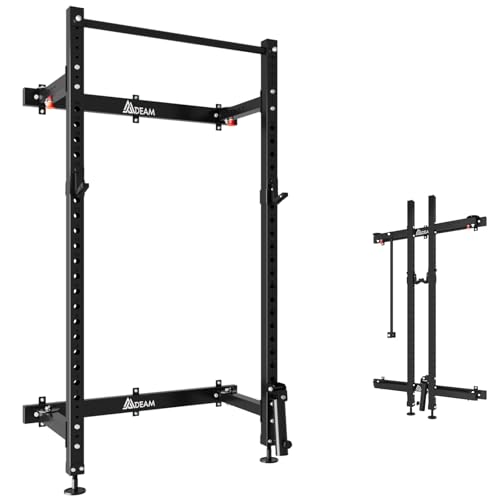
- Folds quickly for space-conscious gyms
- 1,000-pound capacity with 60 x 60 mm uprights
- Includes pull-up, J-hook, and landmine attachments
Best For: Home gym users needing versatile training in limited space
Best All-in-One Cable System

- Combines rack, pulleys, crossover, and pull-up functions
- Five configurations for different training needs
- 2,000-pound listed maximum weight recommendation
Best For: Versatile home gyms prioritizing cable and barbell training
Best Adjustable Barbell Rack

- Offers 17 adjustable barbell rack levels
- Supports up to 1,000 pounds
- Includes a built-in pull-up bar
Best For: Lifters wanting adjustable barbell support in a compact gym
Most Versatile

- Folds to 4.3 sq. ft. for storage
- Includes dual independent pulley training
- Five configurations and 2,000-lb. rated capacity
Best For: All-in-one strength and cable training in compact spaces
Best Heavy-Duty Value

- Supports up to 1,000 pounds
- Folds or opens in about 15 seconds
- Includes pull-up bar, J-cups, safety catches, and row attachment
Best For: Space-conscious home barbell training
Best Attachment Flexibility
JELENS FS01 Folding Squat Rack
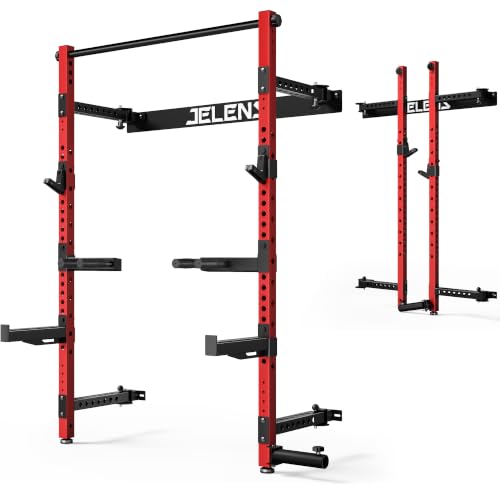
- Folds to about 2.08 sq. ft.
- Includes J-hooks, pull-up bar, landmine, and safety bars
- Provides 23 front and 12 side hole positions
Best For: Customizable home racks with compact storage
Heavy-Duty Space Saver – Mikolo Folding Wall-Mounted Squat Rack
For lifters comparing folding squat racks, the Mikolo QJ combines a wall-mounted design with a 1,000-pound capacity and basic power-rack attachments. It folds from a 47-by-19.7-by-85.8-inch working footprint to a compact 47-by-2-by-85.8-inch stored profile, with the manufacturer stating that the transition takes about 15 seconds.
Best For: Home-gym users who want a heavy-duty folding rack for squats, bench presses, deadlifts, and pull-ups without giving up much floor space.
Pros:
- 2-by-2-inch, 13-gauge steel uprights support up to 1,000 pounds.
- Includes a pull-up bar, J-hooks with UHMW plastic inserts, safety catches, and a 360-degree T-bar row attachment.
- Stringer and metal studs are included for installation, with an advertised 15- to 30-minute setup.
Cons:
- It must be securely wall-mounted, so placement and installation quality matter.
- The package weighs about 43.09 kg, which may make handling during installation difficult.
This Mikolo is a straightforward choice when rack strength and storage efficiency matter more than integrated cable-training features. Its included attachments add useful exercise options while keeping the overall design relatively focused.
Family Training Hub – Mdeam Folding Squat Rack with Pulley System
The Mdeam stands out among folding squat racks by adding a dual cable pulley system to the wall-mounted rack format. Its 2-by-2-inch, 14-gauge steel frame, seven adjustable angles, pull-up bar, lat-pulldown capability, and 360-degree landmine create a broad setup for strength and cable exercises.
Best For: Families or home-gym users who want multiple people to train with a versatile rack and independent cable system.
Pros:
- 1:1 dual pulley system supports independent crossover movements and is described as usable by up to three people simultaneously.
- Combines a power cage, cable crossover, lat-pulldown station, pull-up bar, and landmine.
- Four adjustable ground-support feet and reinforced screw-in wall mounts are designed for stability.
- Folds for storage and offers seven adjustable angles for different spaces and exercises.
Cons:
- At about 151 pounds packaged, it may require substantial effort and help to position or install.
- The one-year warranty is shorter than the coverage listed for some competing models.
Choose this Mdeam model if cable training is as important as barbell work. It offers more integrated functionality than a basic folding rack, although that added equipment also means a larger, heavier installation project.
Balanced All-Rounder – RitFit PMW02 Folding Squat Rack
The RitFit PMW02 is a practical folding squat rack for home users who want a sturdy wall-mounted frame with useful attachments. It opens to 47-by-19.7-by-85.5 inches and folds to a 47-by-2-by-85.8-inch profile, while its 60-by-60 mm, 1.8 mm-thick steel uprights are rated for up to 1,000 pounds.
Best For: Home lifters looking for a compact rack that covers squats, bench presses, pull-ups, and landmine exercises.
Pros:
- Supports up to 1,000 pounds with 60-by-60 mm steel uprights.
- Includes J-hooks, a pin-on pull-up bar, a 360-degree landmine, and necessary mounting hardware.
- Folds nearly flat for storage and is designed to reduce movement through wall mounting.
- Offers 36 months of coverage for the main steel frame and 12 months for accessories.
Cons:
- Installation requires careful drilling and a suitable wall; the notes specifically exclude weight-bearing walls.
- Unlike the pulley-equipped models, it does not list an integrated cable system.
RitFit’s PMW02 makes sense for buyers who prioritize a conventional rack setup and longer frame warranty over advanced cable functionality. Its compact folded dimensions and included landmine keep the training options broad without adding a full pulley station.
Full-Body Functional Trainer – Mikolo Folding Squat Rack with Cable Crossover
This Mikolo model is one of the more feature-rich folding squat racks, combining a power rack, cable crossover, lat pulldown, pull-up bar, and functional trainer. It expands to about 9.5 square feet and folds to roughly 3 square feet, with five operating modes and a 1:1 independent pulley system.
Best For: Users who want a single wall-mounted machine for barbell training, cable work, and a wide range of full-body exercises.
Pros:
- Five configurations include folded, semi-open, power rack, functional trainer, and cable crossover modes.
- Independent 1:1 pulleys support supersets, drop sets, and simultaneous training with others.
- Features a detachable pull-up bar, J-hooks, four adjustable ground feet, and 15 pulley height options.
- 2-by-2-inch, 14-gauge steel construction is rated for up to 1,000 pounds.
Cons:
- At about 150 pounds, the unit may be demanding to transport and install.
- Its many components create a more involved setup than a basic folding rack.
- The listed manufacturer warranty is one year.
For buyers seeking the broadest exercise selection in a compact footprint, this Mikolo offers the strongest all-in-one feature set of the group. It is best suited to users prepared for a heavier installation and who will take advantage of both the rack and pulley functions.
Best Compact Wall-Mounted Pick – Mdeam Folding Squat Rack
If you need folding squat racks for a home, garage, or basement gym, the Mdeam model offers a practical balance of compact storage and full-body training options. It folds in about 15 seconds and includes attachments for squats, presses, pull-ups, rows, and landmine movements.
Best For: Home gym users who want a sturdy, space-saving rack with versatile included attachments.
Pros:
- Folds from a 25-inch-deep setup to a compact 4-inch-deep storage profile.
- Uses 60 x 60 mm steel uprights and is rated to support up to 1,000 pounds.
- Includes a pull-up bar, J-hooks, and 360-degree landmine attachment.
- Wall mounting and adjustable stabilizer feet help improve stability on uneven floors.
Cons:
- Wall mounting is required, so installation needs a suitable surface.
- Its 87-inch height may not suit rooms with low ceilings.
With a one-year warranty and a relatively quick installation process, this rack is a strong choice when floor space matters but you still want several barbell and bodyweight exercises in one setup.
Best All-in-One Cable System – WM3-V4 Folding Squat Rack
Among folding squat racks, the WM3-V4 stands out for combining a power rack with a dual independent pulley system. Its multiple configurations support barbell training, pull-ups, cable crossovers, rows, and other cable exercises while folding down to about 4.3 square feet for storage.
Best For: Users who want one space-saving station for both traditional strength training and cable-based workouts.
Pros:
- Offers folded, semi-open, half-rack, functional-trainer, and cable-crossover modes.
- Includes dual 1:1 pulley systems with 15 adjustable pulley heights.
- Supports a wide range of exercises with a pull-up bar, J-hooks, and safety arms.
- Listed with a 2,000-pound maximum weight recommendation and one-year warranty.
Cons:
- Its broader functionality may make setup and use more involved than a basic folding rack.
- The supplied notes do not specify the included weight plates or a weight stack.
This is the most feature-rich option of the three, particularly for lifters who value cable versatility and multiple training modes alongside a folding design.
Best Adjustable Barbell Rack – Soozier Folding Squat Rack
The Soozier folding squat rack is designed for limited-space home gyms and garages, with a wall-mounted frame that folds to roughly 48 by 2 by 89.8 inches. Its 17 adjustable barbell rack levels make it easier to set up for different exercises and user heights.
Best For: Beginners and experienced lifters who want straightforward barbell support with adjustable height settings and a built-in pull-up bar.
Pros:
- Provides 17 height levels ranging from 9.8 to 72.8 inches.
- Supports up to 1,000 pounds according to the supplied specifications.
- Includes an integrated pull-up bar for added bodyweight training.
- Wall-mounted construction helps minimize movement during workouts.
Cons:
- It does not list cable or landmine attachments in the supplied details.
- Wall installation is necessary for use.
- Its 89.8-inch height may require adequate ceiling clearance.
At 60 pounds, this is a relatively focused option for users who mainly need adjustable barbell positions and pull-up capability without the added complexity of a cable system.
Most Versatile – WM3-V4 Folding Squat Rack
The WM3-V4 stands out among folding squat racks by combining a wall-mounted power rack with a dual independent pulley system. Its five configurations, adjustable pulley positions, and compact folded footprint make it suitable for varied training in a limited space.
Best For: Lifters who want an all-in-one rack and cable machine for apartments, garages, or basements.
Pros:
- Folds to 4.3 square feet and expands to 12.3 square feet when deployed.
- Combines a power rack, cable crossover, functional trainer, lat pulldown station, and pull-up bar.
- Dual independent 1:1 pulleys and 15 height positions support a broad range of exercises.
- Rated for up to 2,000 pounds, with J-hooks and safety arms included.
Cons:
- Installation arrives in two boxes and requires following the included instructions.
- Its many functions may be more than needed for buyers seeking a basic squat rack.
This is the most feature-rich option in the group, especially for users who want cable training without adding a separate machine. Its one-year warranty and setup manual provide additional purchase support.
Best Heavy-Duty Value – Mikolo Folding Squat Rack
The Mikolo is a practical choice among folding squat racks for home lifters who prioritize a strong steel frame and straightforward wall storage. It folds or opens in about 15 seconds and includes core rack accessories for barbell training.
Best For: Home gym users who want a heavy-duty folding rack for squats, deadlifts, bench presses, and pull-ups.
Pros:
- 2-inch by 2-inch, 13-gauge steel uprights support up to 1,000 pounds.
- Quickly switches between its folded and open configurations.
- Includes a pull-up bar, J-cups with UHMW plastic inserts, safety catches, and a landmine-style T-bar row attachment.
- Stringer and metal studs are included for installation, with an estimated 15- to 30-minute setup.
Cons:
- Its open depth is 19.7 inches, so users should check bar and bench clearance.
- The design is focused on rack training rather than an integrated pulley system.
With a 1,000-pound capacity and useful included attachments, the Mikolo offers a balanced setup for conventional barbell workouts. Its wall-mounted format helps preserve floor space without giving up safety catches or pull-up capability.
Best Attachment Flexibility – JELENS FS01 Folding Squat Rack
The JELENS FS01 is a space-saving option among folding squat racks, using a wall-mounted steel frame that folds flat when not in use. Its numerous front and side holes, safety bars, and included attachments allow users to adapt the rack for several home-gym movements.
Best For: Home gym owners who want a compact rack with multiple attachment and mounting-position options.
Pros:
- Folds to a footprint of about 2.08 square feet and opens in approximately 15 seconds.
- 2-inch by 2-inch heavy-duty steel construction is designed for up to 1,100 pounds.
- Includes J-hooks, a pin-on pull-up bar, a 360-degree landmine, and safety bars.
- Offers 23 front and 12 side hole positions for accessory flexibility.
Cons:
- Installation is estimated to take two people about 30 minutes.
- The rack must be securely mounted to a suitable wall for stable use.
- The listed one-year warranty is shorter than the two-year warranty noted for the Mikolo.
The FS01 makes a strong case for buyers who value adjustability and attachment compatibility in a small footprint. Its pre-drilled stringers and included metal studs simplify installation, though wall mounting still requires careful planning.
How We Picked the Best Folding Squat Racks
We focused on the features that matter most in a wall-mounted rack: frame dimensions, stated weight capacity, folding mechanism, mounting requirements, included accessories, and exercise versatility. We also considered whether each design is better suited to basic barbell training or a broader home-gym setup with cables and functional-training attachments.
Because installation affects safety, we gave particular attention to racks that require secure attachment to wall studs or another structurally suitable surface. A high weight rating does not compensate for inadequate mounting hardware or an unsuitable wall.
Quick Comparison
| Feature | Best For | What to Check |
|---|---|---|
| Basic folding rack | Squats, presses, and pull-ups | Upright size, J-hooks, pull-up bar, and capacity |
| Rack with pulley system | Full-body cable workouts | Pulley layout, carriage adjustment, and included handles |
| Rack with multiple attachments | Exercise variety | Compatibility, storage, and added wall clearance |
| Compact wall-mounted model | Small rooms or shared spaces | Folded depth, hinge clearance, and installation location |
Key Buying Factors for Folding Squat Racks
Wall Compatibility and Installation
Confirm that the rack can be anchored into structural studs, masonry, or another approved surface. Measure the available wall width, ceiling height, and the space needed when the rack is unfolded. You may also need room behind the rack for plates, benches, and cable movement.
Frame Size and Weight Capacity
Common upright sizes vary, and thicker tubing can provide greater rigidity and attachment compatibility. Compare the manufacturer’s capacity with your combined barbell load, bodyweight, and any dynamic movement. Capacity figures should be treated as specifications rather than a substitute for careful installation.
Folding Design and Hardware
Look for secure locking points, sturdy hinges, and a folding motion that does not require excessive lifting. Check whether the rack folds inward, outward, or against the wall, and whether the configuration leaves enough clearance for a barbell and spotter arms.
Attachments and Cable Features
J-hooks and a pull-up bar cover fundamental rack exercises. Dual pulleys, lat pulldowns, cable crossovers, and adjustable attachment points can add substantial versatility, but they also increase footprint, setup complexity, and cost. Make sure the included accessories match your preferred exercises.
Who Should Buy Which Folding Squat Racks?
Choose a straightforward folding rack if your priority is barbell strength training in a limited space. A model with a pull-up bar and reliable J-hooks is usually enough for squats, bench presses, overhead presses, and pull-ups.
Choose a pulley-equipped rack if you want cable rows, pulldowns, flyes, face pulls, and other accessory movements without buying a separate functional trainer. Select a rack with more attachments if several people will use the gym or you want broader exercise variety. For any option, prioritize secure mounting, adequate clearance, and a frame capacity that comfortably exceeds your normal training loads.