The best emergency radios do more than receive weather updates. They can provide backup lighting, charge a phone, and keep critical information available when storms or outages disrupt normal power.
We compared 10 emergency radios across battery capacity, charging options, alert coverage, durability, and everyday usability to help you choose a practical model for your home, vehicle, or go-bag.
Best 10 Emergency Radios Picks for 2026
Best Overall
Raynic 12000mAh NOAA Emergency Radio

- Automatic NOAA alert scanning
- Six charging options and phone charging
- LCD, flashlight, reading lamp, and SOS siren
Best For: Home preparedness, severe weather, and camping
Best Simple Pick
Midland ER310 Emergency Crank Radio

- NOAA weather scan and alert
- Multiple power sources with six AA batteries included
- Flashlight, SOS light, and dog whistle
Best For: Basic emergency kits and outdoor activities
Best Solar Performance
Roxicosly 12000mAh Weather Radio

- Large 8500mm² monocrystalline solar panel
- 12000mAh battery and fast hand crank
- 5W flashlight, reading lamp, NOAA alerts, and IPX6 protection
Best For: Blackouts, storms, and extended outdoor use
Best Compact Waterproof Option
Leaton 10000mAh Hand Crank Radio

- 10000mAh battery with stated phone-charge estimate
- IPX6 splash-resistant compact design
- Manual NOAA, solar, hand crank, and USB-C charging
Best For: Go-bags, vehicles, RVs, and camping
High-Capacity Pick
12000mAh Solar Hand-Crank Radio

- 12000mAh battery with multiple charging methods
- NOAA, FM, and AM reception
- Flashlight, reading lamp, SOS, and phone charging
Best For: Households and campers needing extended backup power
Warranty Pick
FosPower A1 NOAA Weather Radio

- NOAA, AM, FM, and weather-band reception
- Solar, hand-crank, and AAA power options
- 2000mAh power bank with limited lifetime warranty
Best For: Compact home and outdoor emergency kits
Survival Kit Pick
10000mAh Weather Radio with Gear
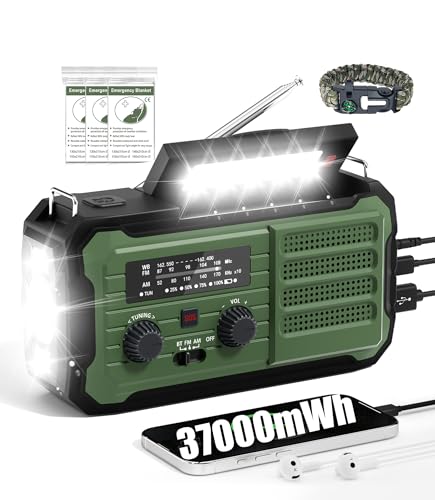
- 37000mWh battery with solar and hand-crank charging
- Automatic scan across seven weather channels
- Includes thermal blanket and survival bracelet
Best For: Preparedness kits, families, and outdoor adventures
Best with Extra Features
12000mAh Solar Hand Crank Radio

- Large 12,000mAh rechargeable battery
- NOAA, AM/FM reception and multiple charging methods
- 5W light, reading lamp, SOS alarm, and rugged water-resistant design
Best For: Preparedness kits, outages, camping, and RV travel
Best Alert-Focused Pick
Raynic NOAA Weather Alert Radio

- Automatic NOAA alert scanning, including standby mode
- Six charging methods with AM/FM/SW/NOAA reception
- LCD display, lights, USB charging, SOS siren, and headphone jack
Best For: Severe-weather monitoring and nighttime preparedness
Best Lightweight Budget-Style Pick

- Lightweight 7.55-ounce portable design
- USB, solar, and hand-crank charging
- AM/FM/NOAA radio, 140-lumen light, and SOS alarm
Best For: Compact emergency kits, cars, camping, and travel
Best Overall – Raynic 12000mAh NOAA Emergency Radio
For shoppers comparing emergency radios, the Raynic stands out for its broad reception, automatic NOAA alert scanning, and unusually flexible charging setup. Its 12000mAh battery, solar panel, hand crank, USB-C input, AC adapter, and optional AAA batteries provide several ways to keep it operating during an outage.
Best For: Home emergency kits, severe-weather preparedness, camping, and anyone who wants automatic alerts plus phone-charging capability.
Pros:
- Automatically scans for and announces NOAA emergency and weather alerts.
- Six charging options include a 12000mAh battery, solar, hand crank, USB-C, AC power, and AAA batteries.
- Combines AM/FM/SW/NOAA reception with a large LCD, 3W flashlight, reading lamp, USB output, and SOS siren.
- Compact, 1.2-pound design includes IPX3 water resistance and a headphone jack.
Cons:
- AAA batteries are not included.
- IPX3 protection is suited to light water exposure rather than heavy weather.
The Raynic is a feature-rich choice when alert automation and multiple backup-power options matter more than keeping the design minimal. The LCD and digital tuning also make it easier to monitor battery status and select stations.
Best Simple Pick – Midland ER310 Emergency Crank Radio
The Midland ER310 is a straightforward option among emergency radios, focusing on essential AM/FM and NOAA weather functions without an oversized battery specification. It offers multiple power sources, an integrated flashlight, and safety-focused extras for emergency kits and outdoor activities.
Best For: Shoppers who want a recognizable, simple emergency radio with NOAA scanning, flashlight functionality, and included AA batteries.
Pros:
- Includes NOAA weather scan and alert functionality.
- Supports multiple power sources and comes with six AA batteries.
- Built-in flashlight, SOS emergency light, and ultrasonic dog whistle add practical emergency features.
- USB connectivity supports compatible smartphones and tablets.
Cons:
- Reception is limited to AM/FM rather than shortwave or broader band coverage.
- It is not water resistant.
- The supplied notes do not specify a high-capacity rechargeable battery.
The ER310 makes sense for buyers who prioritize core weather information and basic emergency signaling over extra lighting modes or a large phone-charging battery. Its included batteries also make it easier to add to a kit immediately.
Best Solar Performance – Roxicosly 12000mAh Weather Radio
This Roxicosly model is one of the more power-focused emergency radios, pairing a large 8500mm² monocrystalline solar panel with a stated 12000mAh battery. It also adds a fast hand-crank generator, dual lighting, NOAA alerts, USB phone charging, and IPX6 waterproof protection for blackout and outdoor use.
Best For: Users who want stronger solar charging potential, substantial backup power, and brighter emergency lighting for storms, camping, or outages.
Pros:
- Large monocrystalline solar panel is designed for improved sunlight capture.
- Real 12000mAh battery supports phone charging, lighting, and radio use.
- 5W adjustable-beam flashlight and 12-LED reading lamp provide two lighting options.
- Offers AM/FM/NOAA bands, NOAA alerts, SOS alarm, USB-C charging, hand crank, and IPX6 water resistance.
Cons:
- It weighs about 824 grams, making it heavier than some compact radios.
- AAA batteries are required as an additional power source.
- The supplied notes do not provide a detailed phone-charge estimate.
Choose this radio when maintaining power and lighting is a higher priority than the lightest possible carry. Its combination of a large solar panel, high-capacity battery, and waterproof housing is particularly suited to demanding outdoor or blackout scenarios.
Best Compact Waterproof Option – Leaton 10000mAh Hand Crank Radio
The Leaton is a compact choice among emergency radios, with a 10000mAh internal battery, IPX6 water resistance, solar and hand-crank charging, and useful lighting. It receives AM/FM and NOAA broadcasts, but its NOAA operation requires manual tuning rather than automatic alerts.
Best For: Go-bags, vehicles, RVs, camping, and buyers who need compact backup power and splash resistance with clearly stated charging expectations.
Pros:
- 10000mAh battery provides USB phone charging, with the notes estimating about 1–1.5 iPhone 14 charges.
- IPX6 water resistance and compact 1.1-pound design suit outdoor storage and travel.
- Three charging modes include USB-C, solar, and hand crank.
- Three-mode flashlight, reading lamp, SOS signaling, and built-in compass add practical utility.
Cons:
- NOAA broadcasts require manual tuning and listening.
- It does not support SAME, automatic NOAA alerts, or location-based alerts.
- IPX6 protection is for water spray and splashing, not immersion or underwater use.
The Leaton is a good fit when portability, splash resistance, and realistic phone-charging information matter. However, shoppers who want warnings without monitoring the broadcast should choose a model with automatic NOAA alert support instead.
High-Capacity Pick – 12000mAh Solar Hand-Crank Radio
For shoppers comparing emergency radios, this model stands out for its large stated 12000mAh lithium battery, multiple charging options, and clear NOAA, FM, and AM reception. It also combines lighting, phone charging, and an easy-grip design for home emergency kits or off-grid use.
Best For: Households and campers who prioritize battery capacity, versatile charging, and strong lighting.
Pros:
- Uses a 12000mAh lithium battery with solar, hand-crank, Type-C, and AAA battery options.
- Supports NOAA, FM, and AM bands with a high-sensitivity signal chip and extended antenna.
- Includes a focused flashlight, soft reading lamp, SOS alarm, and emergency cellphone charging.
- Large controls and a non-slip grip are designed for straightforward operation.
Cons:
- The product notes recommend fully charging it before first use.
- Its 6.8 x 2.9 x 4.7-inch body may be larger than simpler emergency radios.
This is the most feature-rich choice of the three for buyers who want substantial backup power alongside weather updates. The large battery and lighting package are useful during longer outages, while the crank and solar functions provide alternatives when outlets are unavailable.
Warranty Pick – FosPower A1 NOAA Weather Radio
This FosPower model is a practical option among emergency radios for buyers who want NOAA, AM, FM, and weather-band access in a compact, water-resistant design. Its 2000mAh power bank, three charging sources, dual lighting setup, and limited lifetime warranty cover core outage and outdoor needs.
Best For: Buyers seeking a compact weather radio with basic device charging and warranty support.
Pros:
- Receives NOAA emergency broadcasts along with AM, FM, and weather-band stations.
- Offers solar, hand-crank, and AAA battery power options.
- Provides a 2000mAh power bank, 1W flashlight, and four-LED reading light.
- Includes water resistance and a limited lifetime warranty.
Cons:
- The 2000mAh power bank is smaller than the capacities listed for the other two models.
- Its speaker output is listed at 2 watts.
Choose the FosPower A1 when portability and straightforward emergency functionality matter more than maximum battery capacity. It is a sensible backup for weather alerts, modest phone charging, and lighting, with warranty coverage adding extra reassurance.
Survival Kit Pick – 10000mAh Weather Radio with Gear
Among emergency radios, this package is aimed at preparedness buyers who want more than a radio and flashlight. It pairs a stated 10000mAh/37000mWh rechargeable battery and three charging methods with automatic weather scanning, an SOS alarm, a headphone jack, and added survival accessories.
Best For: Families, hikers, and disaster-preparedness kits that need an all-in-one package.
Pros:
- Uses a 37000mWh rechargeable battery with solar, hand-crank, and internal battery power.
- Automatically scans seven available weather-band channels for alerts.
- Includes a flashlight, headphone jack, USB port, and SOS alarm with flashing red light.
- Comes with a thermal blanket and a survival paracord bracelet with compass, cutting blade, whistle, and fire rod.
Cons:
- The supplied notes do not specify dimensions, speaker output, or water-resistance rating.
- The additional survival accessories may be unnecessary for buyers seeking only a basic radio.
This is the broadest preparedness package in the roundup, especially for users who value automatic weather monitoring and extra survival tools. Its accessories increase versatility for outdoor or disaster kits, but a simpler model may be a better fit if your priority is only radio reception and charging.
Best with Extra Features – 12000mAh Solar Hand Crank Radio
For shoppers comparing emergency radios, this rugged OnLyee model stands out for its large battery and broad backup-power options. It combines NOAA, AM, and FM reception with solar and hand-crank charging, plus lighting and phone-charging features for outages, camping, RV travel, and emergency kits.
Best For: Preparedness kits and off-grid use where extended battery capacity and multiple emergency functions matter.
Pros:
- Large 12,000mAh rechargeable battery can power the radio, lights, and emergency phone charging.
- Supports NOAA, AM, and FM reception with DSP tuning, an extended antenna, and a 57mm speaker.
- Includes an oversized 8500mm² solar panel, hand crank, USB-C input, and AAA backup option.
- Combines a 5W flashlight, reading lamp, 120dB SOS alarm, and flashing beacon in a water-resistant, dustproof, shock-resistant body.
Cons:
- At 1.6 pounds, it is heavier than the smallest emergency radios.
- The feature-rich design may be more radio than casual users need.
This is a strong all-around choice when capacity, durability, and versatile charging are higher priorities than minimizing size and weight.
Best Alert-Focused Pick – Raynic NOAA Weather Alert Radio
Among emergency radios, the Raynic is especially useful for people who want automatic warning notifications rather than continuously monitoring a broadcast. Its NOAA alert function, digital LCD display, six charging options, lights, siren, and headphone jack make it a versatile option for home and outdoor preparedness.
Best For: Users who prioritize automatic NOAA alerts, clear digital tuning, and flexible charging in a compact radio.
Pros:
- Automatically scans for and announces emergency and weather alerts, including while in standby mode.
- Large HD LCD displays the battery level and tuning frequency, with digital tuning and a dimmer function.
- Offers six charging methods: rechargeable battery, AC adapter, USB input, hand crank, solar panel, and three AAA batteries.
- Includes AM/FM/SW/NOAA reception, a 3W flashlight, 2.5W reading lamp, USB device charging, SOS siren, and a headphone jack.
Cons:
- AAA batteries are not included.
- Its IPX3 rating provides water resistance, but less protection than more rugged waterproof designs.
The automatic alert capability is the main differentiator, making this Raynic a practical choice for nighttime readiness and severe-weather monitoring.
Best Lightweight Budget-Style Pick – Esky Compact Hand Crank Radio
If portability is the priority, this Esky model is one of the more compact emergency radios to consider. It provides AM/FM/NOAA reception, three charging methods, a built-in battery, bright LED lighting, and an SOS alarm in a lightweight body suited to trunks, suitcases, pockets, and camping gear.
Best For: Lightweight emergency kits, car storage, camping, and users who want basic radio and lighting functions without a bulky design.
Pros:
- Compact 5-by-1.8-by-2.4-inch design weighs only 7.55 ounces and includes a lanyard.
- Charges through USB, solar power, or the hand crank.
- Built-in 2,000mAh battery provides approximately 20 hours of flashlight use or 9 hours of radio use when fully charged.
- 140-lumen, three-LED flashlight, AM/FM/NOAA reception, and SOS alarm add useful emergency functions.
Cons:
- Its 2,000mAh battery is substantially smaller than the capacity offered by larger models.
- It provides fewer listed features and charging options than the Raynic and OnLyee radios.
The Esky is a sensible choice when you need a small, easy-to-carry backup radio with essential lighting and charging features rather than maximum battery capacity.
How We Picked the Best Emergency Radios
We focused on features that matter during outages and severe weather rather than cosmetic extras. Our comparison considered AM/FM and NOAA alert coverage, battery capacity, hand-crank and solar charging, USB phone-charging capability, flashlight design, portability, and ease of use. We also noted where a radio offers shortwave reception, headphone support, or multiple lighting modes.
Battery ratings are useful for estimating backup power, but real-world runtime varies with volume, flashlight use, charging efficiency, and battery age. Solar charging is best treated as a maintenance or emergency supplement, while hand-crank charging is the most dependable option when no other power source is available.
Quick Comparison
| Feature | What to look for | Why it matters |
|---|---|---|
| Weather alerts | NOAA reception and alert capability | Provides timely warnings for storms and other hazards |
| Battery capacity | About 2,000mAh to 12,000mAh | Determines how long the radio and connected devices can run |
| Charging | Hand crank, solar, USB, or battery backup | Provides multiple ways to restore power |
| Lighting | Flashlight, reading lamp, or multiple LEDs | Improves visibility during outages |
| Portability | Compact body, carrying handle, and manageable weight | Makes the radio easier to store or take on the road |
Key Buying Factors for Emergency Radios
Battery and Charging Options
Choose capacity based on how you expect to use the radio. Larger batteries are better for repeated phone charging and longer listening, but they often make the unit heavier. A hand crank should be easy to turn and ideally work independently of the internal battery. Solar panels are useful when placed in direct sunlight, though they typically charge slowly.
Alert and Reception Features
NOAA weather-band reception is a priority for storm preparedness. AM/FM support helps with local news and general updates, while shortwave can expand listening options in some locations. Test reception in the room where you plan to store the radio, since buildings and terrain affect signal quality.
Phone Charging and Lighting
USB output can provide valuable emergency power, but do not assume every radio can fully recharge a modern smartphone. Check the output specifications and connector compatibility. A bright flashlight is useful for navigation, while a side or top reading lamp is better for illuminating a room.
Build and Controls
Look for clearly labeled controls, a readable tuning display, a stable handle, and a design that is easy to operate without perfect lighting. Keep the radio charged, periodically test its alert function, and store compatible cables with it.
Who Should Buy Which Emergency Radios?
Choose a high-capacity 10,000mAh- or 12,000mAh-class model if you want emergency backup power for phones and extended outages. A mid-capacity option is a better balance for a household kit that needs alerts, lighting, and occasional charging without excessive bulk. Compact 2,000mAh- or 7,400mWh-class radios suit car emergency kits, smaller go-bags, and buyers who prioritize portability.
For the most dependable preparedness setup, select a radio with NOAA alerts, hand-crank charging, a usable flashlight, and a battery level you can monitor. Whichever model you choose, test it before an emergency and keep it somewhere accessible.