When severe weather cuts power or cell service, the right emergency radio can provide critical alerts, basic lighting, and a way to recharge a phone. Solar charging adds a renewable backup, while a hand crank helps when sunlight is limited.
We compared 10 emergency radios with solar charging across battery capacity, alert coverage, charging options, lighting, portability, and everyday usability so you can choose a practical model for your home, car, or emergency kit.
Best 10 Emergency Radios with Solar Charging Picks for 2026
Balanced Backup
FosPower A1 Solar Weather Radio

- 7400mWh power bank for small devices
- Solar, crank, USB-C, and AAA power options
- NOAA radio, dual lights, and SOS alarm
Best For: General home and storm preparedness
High-Capacity Utility
RunningSnail 4000mAh Emergency Radio

- 14800mWh battery for smartphone charging
- Solar, crank, Micro USB, and battery power
- Three-mode flashlight and motion reading lamp
Best For: Family emergency kits and camping
Maximum Battery
10000mAh Solar Emergency Radio
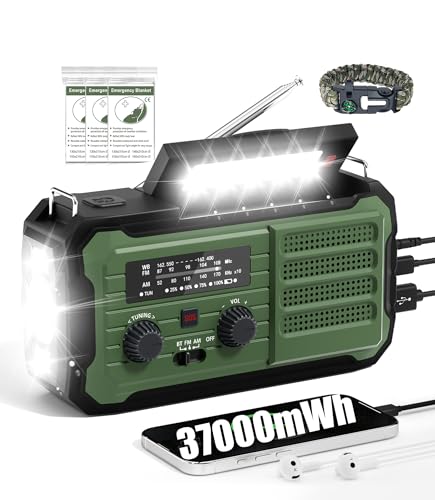
- 37000mWh rechargeable battery
- Automatic scan across seven weather channels
- Includes blanket and survival paracord bracelet
Best For: Extended outages and outdoor preparedness
Connected Convenience
Yesiwtc 2000mAh Hand Crank Radio
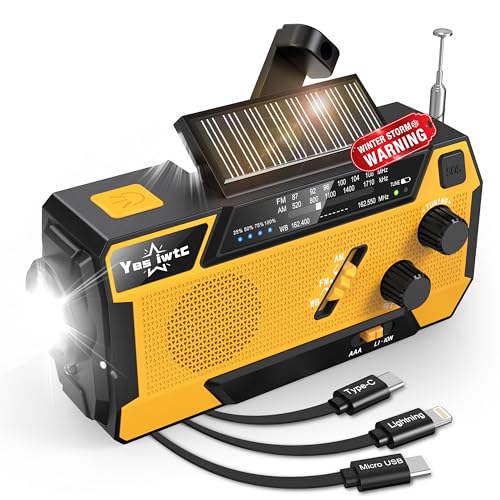
- Three built-in cables for common devices
- Four power sources including solar and AAA
- Three-mode flashlight and six LED reading lights
Best For: Mixed-device household emergency kits
Best High-Capacity Compact Pick
Leaton 10,000mAh Emergency Radio

- 10,000mAh backup battery
- Solar, hand-crank, and USB-C charging
- IPX6 resistance with flashlight and compass
Best For: Large-battery backup power in a compact emergency radio
Best Automatic Alert Pick

- Automatic NOAA alert scanning
- Six charging options, including solar
- LCD tuning, SOS alarm, and headphone jack
Best For: Households wanting hands-off severe-weather notifications
Best Extended-Runtime Pick

- 20,000mAh battery with up to 35-hour radio runtime
- Solar, hand-crank, and USB-C charging
- IPX6 protection with strong lighting features
Best For: Extended outages requiring long radio and lighting runtime
Top Solar-Powered Pick
Large-Panel Emergency Weather Radio

- Large 8500mm² solar panel
- 12000mAh battery and five power options
- NOAA alerts, dual lights, and IPX6 design
Best For: Home emergency kits, blackouts, hurricanes, and camping
Best for Clear Broadcasts
Solar and Hand-Crank NOAA Radio

- 7 NOAA channels plus AM/FM
- DSP processing and 57mm speaker
- 12000mAh battery with USB backup charging
Best For: Weather monitoring, blackouts, RVs, and emergency kits
Best Compact Option
WVL Portable Solar Hand-Crank Radio
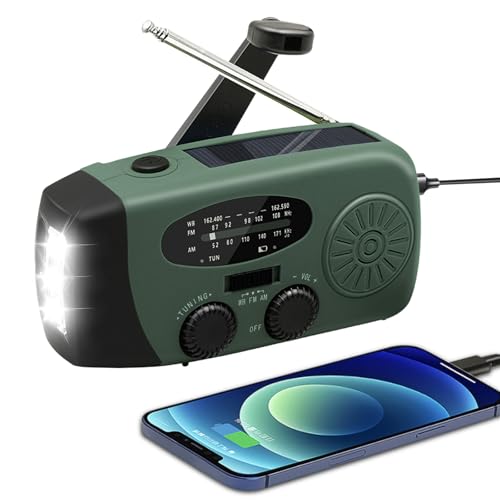
- Lightweight 231g pocket-sized design
- Solar, hand-crank, and battery power
- 2000mAh charger with lights and SOS siren
Best For: Go bags, car kits, camping, and lightweight emergency carry
Balanced Backup – FosPower A1 Solar Weather Radio
The FosPower A1 is a practical choice among emergency radios with solar charging, combining NOAA, AM, and FM reception with several backup power options. Its built-in power bank, dual lights, and SOS alarm make it useful for home power outages, storm preparation, and outdoor emergencies.
Best For: Households wanting a compact, versatile emergency radio with phone charging and a limited lifetime warranty.
Pros:
- 7400mWh (2000mAh) power bank can provide emergency power for a phone or small tablet.
- Solar charging, hand-crank charging, and AAA battery support provide multiple ways to maintain power.
- Includes NOAA/AM/FM reception, a 1W flashlight, four-LED reading light, and SOS alarm.
Cons:
- The power bank is smaller than the 4000mAh and 10000mAh options in this roundup.
- Requires four AAA batteries when rechargeable power cannot be regenerated.
The FosPower stands out as a well-rounded emergency kit radio rather than a high-capacity power station. Its combination of weather updates, lighting, charging, and warranty support makes it a dependable general-purpose option.
High-Capacity Utility – RunningSnail 4000mAh Emergency Radio
For shoppers comparing emergency radios with solar charging, the upgraded RunningSnail emphasizes battery capacity and flexible everyday usability. It combines a 4000mAh battery with NOAA weather reception, four charging options, a three-mode flashlight, and a motion-sensor reading lamp.
Best For: Families and campers who want a larger battery, clear weather alerts, and versatile lighting in one unit.
Pros:
- The 14800mWh (4000mAh) battery is designed to charge smartphones during power shortages.
- Supports Micro USB, solar, hand-crank, and built-in battery power.
- Offers NOAA/AM/FM reception, an external antenna, three-mode flashlight, and motion-sensor reading lamp.
Cons:
- The supplied details identify the primary power source as battery powered, so charging specifications should be checked carefully.
- Its 1-watt speaker output is lower than the listed output of some competing models.
This RunningSnail model is a strong middle ground for emergency kits that need more phone-charging capacity without moving to the largest battery option. Its lighting features also make it useful beyond severe-weather situations.
Maximum Battery – 10000mAh Solar Emergency Radio
This 10000mAh model is the high-capacity pick among these emergency radios with solar charging. It pairs a 37000mWh rechargeable battery with solar and hand-crank charging, automatic NOAA weather scanning, a flashlight, headphone jack, SOS alarm, and additional survival accessories.
Best For: Preparedness-minded households and outdoor users who prioritize extended battery capacity and included survival gear.
Pros:
- The 37000mWh battery offers the largest stated capacity in this group.
- Automatic scanning across seven weather-band channels is designed to help surface emergency alerts.
- Includes a flashlight, headphone jack, USB port, SOS alarm, thermal blanket, and survival paracord bracelet.
Cons:
- The supplied notes describe three charging methods, so it has fewer stated charging options than some models with USB and AAA support.
- The added survival accessories may be unnecessary for shoppers seeking only a basic radio.
The main reason to choose this radio is its unusually large stated battery and automatic weather scanning. It is best suited to buyers who value longer reserve power and bundled emergency equipment over a simpler, lighter setup.
Connected Convenience – Yesiwtc 2000mAh Hand Crank Radio
The Yesiwtc 2000mAh model is a flexible option for shoppers seeking emergency radios with solar charging and convenient device compatibility. Its 7400mWh battery, three built-in charging cables, four power sources, weather-band reception, and adjustable lighting cover the core needs of a home emergency kit.
Best For: Users who want built-in Lightning, USB-C, and Micro USB cables alongside solar, crank, USB-C, and AAA power options.
Pros:
- Three integrated cables can charge Lightning, USB-C, and Micro USB devices without separate cords.
- Supports USB-C, solar, hand-crank, and AAA battery power.
- Includes NOAA/AM/FM/weather-band reception, three flashlight modes, six LED reading lights, and an SOS alarm.
Cons:
- The 2000mAh battery provides less capacity than the 4000mAh and 10000mAh alternatives.
- Although listed as waterproof in the details, the supplied notes do not specify a water-resistance rating.
This radio’s standout advantage is connectivity: the built-in cables reduce the chance of misplacing a charging lead during an outage. It is a particularly practical choice for households with a mix of common device connectors.
Best High-Capacity Compact Pick – Leaton 10,000mAh Emergency Radio
If you want emergency radios with solar charging for a home kit, vehicle, or camping setup, the Leaton combines a large rechargeable battery with solar and hand-crank backup. It also provides NOAA, AM, and FM reception, though weather broadcasts require manual tuning rather than automatic alerts.
Best For: Buyers who prioritize a large battery, backup phone charging, and compact outdoor-friendly lighting.
Pros:
- 10,000mAh battery can provide approximately 1–1.5 iPhone 14 charges, depending on conversion and device efficiency.
- Supports USB-C, solar, and hand-crank charging.
- IPX6 water resistance, three-mode flashlight, reading lamp, and built-in compass add practical emergency features.
- Large controls may be easier for families and seniors to operate.
Cons:
- NOAA reception requires manual tuning and does not provide SAME or automatic alerts.
- IPX6 protection is intended for splashes and spray, not immersion or heavy rain.
- Solar and hand-crank charging are backup methods and may be slow.
The Leaton is a well-rounded choice when battery capacity and compact outdoor utility matter most. Choose it over an alert-focused model only if manual NOAA listening meets your needs.
Best Automatic Alert Pick – Raynic NOAA Emergency Radio
Among emergency radios with solar charging, the Raynic stands out for its automatic NOAA alert capability. Its digital tuning, LCD display, multiple power options, and alert siren make it a strong fit for households that want weather warnings without monitoring a broadcast continuously.
Best For: Families and outdoor users who want automatic NOAA alerts, readable digital controls, and flexible charging.
Pros:
- Automatic NOAA alert scanning can warn users about emergency weather messages while the radio is on or in standby.
- Six power options include rechargeable battery, AC adapter, USB input, hand crank, solar panel, and three AAA batteries.
- Digital tuning and a large LCD show the frequency and battery level.
- Includes flashlight, reading lamp, USB device charging, SOS alarm, and headphone jack.
Cons:
- IPX3 water resistance offers less protection than higher-rated alternatives.
- AAA batteries are not included.
- Its approximately 1.2-pound build may be less convenient than smaller radios for lightweight kits.
The Raynic is the most suitable option here for users who value automatic weather notifications. Its broad charging support also makes it practical when both grid power and normal battery access are uncertain.
Best Extended-Runtime Pick – QAUYYW 20,000mAh Solar Radio
The QAUYYW is one of the most battery-focused emergency radios with solar charging, pairing a stated 20,000mAh capacity with hand-crank, solar, and USB-C input. It is designed for extended listening and lighting during outages, while its NOAA operation still requires manual tuning to a local station.
Best For: Emergency kits needing extended radio runtime, substantial backup power, and IPX6 outdoor protection.
Pros:
- Stated 20,000mAh battery supports up to 35 hours of radio use at medium volume.
- Reading light is rated for up to 50 hours of continuous use.
- Offers USB-C, solar, and hand-crank charging, plus USB output for brief phone or device charging.
- IPX6 protection, SOS alarm, 3W flashlight, and extended antenna support outdoor preparedness.
Cons:
- NOAA warnings require the radio to be powered on and manually tuned; it is not an automatic alert system.
- Phone charging is intended for brief calls or texts rather than extensive device use.
- Large battery capacity may make it less ideal when minimum pack weight is the priority.
The QAUYYW is appealing when long runtime is more important than advanced alert automation. Its lighting, charging, and weather-resistance features make it particularly suited to extended outages and outdoor emergency use.
Top Solar-Powered Pick – Large-Panel Emergency Weather Radio
For shoppers comparing emergency radios with solar charging, this Roxicosly model stands out for its large 8500mm² monocrystalline solar panel, substantial 12000mAh battery, and five charging methods. It also combines NOAA alerts, AM/FM reception, two lights, and an SOS alarm in a rugged IPX6 waterproof design.
Best For: Home blackout kits, hurricane preparedness, camping, and anyone prioritizing battery capacity and flexible recharging.
Pros:
- Large solar panel and efficient hand-crank generator provide multiple backup charging options.
- Real 12000mAh battery can power the radio, lights, and emergency phone charging.
- Includes a 5W adjustable flashlight, 12-LED reading lamp, NOAA alerts, and SOS alarm.
- IPX6 waterproof construction and a compact rugged design suit indoor or outdoor emergencies.
Cons:
- Its larger battery and lighting features may be more than casual users need.
- AAA batteries are required separately as an additional power option.
This is a strong all-around choice when dependable reserve power matters as much as weather information. Its large panel and 12000mAh battery make it especially practical for extended outages, though smaller radios may be easier to pack.
Best for Clear Broadcasts – Solar and Hand-Crank NOAA Radio
This OnLyee model is a practical option among emergency radios with solar charging, pairing an 8500mm² solar panel with hand-crank and USB Type-C charging. Its DSP signal processing, 57mm speaker, 7 NOAA weather broadcasts, and 12000mAh battery make it suited to staying informed and powered during outages.
Best For: Users who want clear AM/FM and NOAA broadcasts alongside strong lighting and phone backup charging.
Pros:
- Supports 7 NOAA weather broadcasts plus AM/FM reception.
- Large solar panel, hand crank, and Type-C input offer flexible recharging.
- 12000mAh battery can run the radio and lights while providing emergency USB charging.
- 5W flashlight, 12-LED reading lamp, and 120dB SOS alarm add useful emergency functions.
Cons:
- NOAA alerts require the radio to be powered on and tuned to a NOAA station.
- At 1.6 pounds, it is less lightweight than a pocket-sized emergency radio.
Choose this version if broadcast clarity and a louder speaker are high priorities. It offers a well-rounded mix of weather reception, reserve power, and emergency lighting, although its size may be less convenient for ultralight kits.
Best Compact Option – WVL Portable Solar Hand-Crank Radio
For a smaller emergency radio with solar charging, the WVL combines a built-in rechargeable battery, solar panel, and hand crank in a compact 231g body. It also provides AM/FM/WB reception, a flashlight, motion-sensor reading lamp, SOS siren, and emergency phone charging.
Best For: Lightweight go bags, camping, car kits, and users who want basic emergency functions in a pocket-friendly format.
Pros:
- Compact 5.9-by-3.07-by-2.4-inch design weighs about 231g.
- Three power sources include solar charging, hand crank, and a built-in Li-ion battery.
- Includes AM/FM/WB reception, NOAA weather channels, flashlight, reading lamp, and SOS alarm.
- Offers a 2000mAh emergency phone charger and 18-month returns with lifetime technical support.
Cons:
- The 2000mAh phone charger is substantially smaller than the 12000mAh batteries in the other models.
- Its 1.5W flashlight and compact build provide less lighting power than larger radios.
- Specifications list 3-band reception, so it offers fewer stated bands than the other two options.
The WVL is the easiest model here to carry and store, making it a sensible supplement for a go bag or vehicle kit. Its smaller battery and lighter-duty lighting favor portability over extended phone charging or maximum illumination.
How We Picked These Emergency Radios with Solar Charging
We focused on features that matter during outages and emergencies rather than appearance alone. Each selected model offers solar charging and a hand crank, along with some combination of NOAA weather alerts, AM/FM reception, built-in lighting, and USB phone charging. We also considered battery capacity, charging flexibility, portability, control layout, and useful extras such as reading lamps, headphone outputs, and multiple light modes.
Battery ratings can vary between milliamp-hours and watt-hours, and real-world runtime depends on brightness, volume, signal strength, and charging conditions. Treat the listed capacity as a comparison point, not a guarantee of phone charges or radio runtime.
Quick Comparison
- Best all-around feature set: Look for NOAA alerts, AM/FM reception, a capable flashlight, and USB charging in a compact design.
- Best for longer backup power: Prioritize models advertising higher capacities, such as 10,000mAh or 20,000mAh, while checking size and weight.
- Best for compact emergency kits: Choose a smaller radio with straightforward controls and enough battery capacity for alerts and occasional lighting.
- Best for nighttime use: A model with both a focused flashlight and a reading lamp is more versatile during a blackout.
Key Buying Factors for Emergency Radios with Solar Charging
Weather Alerts and Reception
NOAA compatibility is especially valuable in the United States because it can deliver weather information when internet access is unavailable. Some radios include alert modes that notify you when warnings are broadcast. AM/FM support adds useful local news and emergency information, while shortwave or SW reception may broaden coverage but is not essential for every buyer.
Charging and Battery Capacity
Solar panels are best viewed as a slow maintenance or emergency charging option, not a fast replacement for a wall charger. Hand cranking is useful in immediate emergencies but requires effort. USB, wall, and car charging provide faster everyday preparation. Higher-capacity batteries can power phones and lights longer, but they generally add bulk and may take longer to recharge.
Lighting, Durability, and Usability
Check whether the radio has a bright directional beam, a reading lamp, or both. Large controls and a simple interface are helpful in darkness or stressful conditions. A sturdy handle, protected ports, a readable indicator, and a manageable size also matter. Do not assume water resistance unless the manufacturer clearly states an appropriate rating.
Who Should Buy Which Emergency Radios with Solar Charging?
Home emergency planners should favor a higher-capacity model with NOAA alerts, USB charging, and separate flashlight and reading-lamp functions. Drivers and campers may prefer a lighter radio that fits easily in a glove box or backpack. Households preparing for extended outages should prioritize multiple charging methods and a larger battery, while keeping a separate power bank for critical phone charging. Occasional users can save space and money with a basic model that covers weather alerts, radio reception, lighting, solar charging, and hand-crank operation.
Whichever model you choose, charge it before storing it, test the radio and lights periodically, and keep the manual and charging cables with your emergency supplies.