The best emergency radios for camping help you stay informed when storms, power outages, or weak cell service disrupt your plans. The models in this roundup combine weather alerts with backup power and practical lighting features.
We compare 10 options across charging methods, battery capacity, radio reception, durability, and ease of use so you can choose a dependable radio for your campsite, vehicle, or emergency kit.
Best 10 Emergency Radios for Camping Picks for 2026
Compact Power Pick

- USB, solar, and hand-crank charging
- 2000mAh battery with AM/FM/NOAA reception
- 140-lumen flashlight and SOS alarm
Best For: Lightweight camping emergency kits
Feature-Rich Preparedness Pick

- NOAA weather scan and alert
- Six included AA batteries plus solar power
- Flashlight, USB connectivity, and dog whistle
Best For: Feature-focused outdoor preparedness
Lightweight Charging Pick

- Compact 7.84-ounce design
- 2000mAh battery with solar and crank charging
- AM/FM/NOAA, flashlight, and USB charging
Best For: Backpacking and compact camping kits
Extended Coverage Pick

- 2000mAh power bank for phones and small tablets
- Solar, crank, USB, and AAA battery options
- Flashlight plus four-LED reading light
Best For: Family camping and base-camp preparedness
Versatile Power Pick

- Five-plus power options, including solar and hand crank
- AM/FM, shortwave, and seven NOAA channels
- Reading lamp, flashlight, SOS beacon, and USB output
Best For: Campers wanting broad coverage and flexible backup power
High-Capacity Outdoor Pick
Leaton 10000mAh Emergency Radio

- Large 10000mAh battery with USB phone charging
- IPX6 splash resistance and built-in compass
- Solar, hand-crank, and USB-C charging
Best For: Outdoor users prioritizing battery capacity and splash resistance
Automatic Alert Pick

- Automatic NOAA alert scanning, including standby mode
- Six charging methods and rechargeable backup battery
- LCD tuning, lighting, SOS alarm, and headphone jack
Best For: Campers seeking automatic weather alerts and digital controls
High-Capacity Pick
QAUYYW 20,000mAh Solar Hand Crank Radio

- 20,000mAh battery with extended radio runtime
- Solar, hand-crank, and USB-C charging
- IPX6 design with lighting and SOS alarm
Best For: Extended off-grid trips and high-capacity emergency kits
Rugged Outdoor Pick
OnLyee 12,000mAh NOAA Weather Radio

- Rugged, water-resistant, dustproof, shock-resistant build
- Solar, hand-crank, USB-C, and AAA backup power
- 5W flashlight and 120dB SOS beacon
Best For: Rugged camping, RV travel, and vehicle emergency kits
Compact Budget Pick
WVL Portable Solar Hand Crank Radio
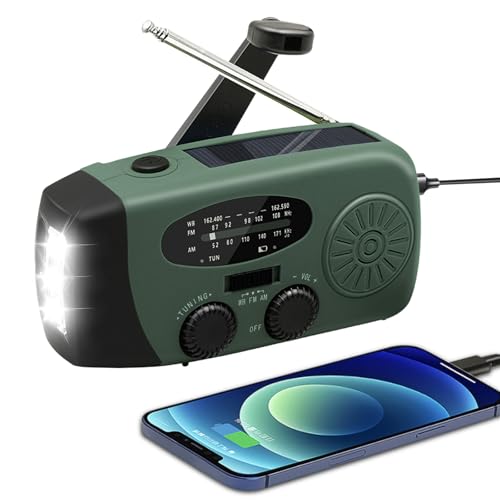
- Lightweight 231-gram portable design
- Three power sources for emergency use
- Flashlight, reading lamp, SOS alarm, and phone charger
Best For: Day hikes and lightweight camping kits
Compact Power Pick – Esky 3-Mode Emergency Radio
For campers who want dependable information, lighting, and backup charging in a small package, this Esky is a practical choice among emergency radios for camping. It receives AM, FM, and NOAA weather broadcasts and offers USB, solar, or hand-crank charging.
Best For: Campers who prioritize a lightweight radio with multiple charging options and an SOS alarm.
Pros:
- Three charging methods: USB, solar, and hand crank
- 2000mAh battery provides approximately 9 hours of radio use or 20 hours of flashlight use when fully charged
- 140-lumen, three-LED flashlight plus SOS alarm
- Compact 5-inch design weighs just 7.55 ounces
Cons:
- Its listed water-resistance rating is not specified
- The battery should be charged regularly when stored
The Esky combines core emergency functions in a pocket-friendly design. Its three power options make it particularly useful when outlets are unavailable, though regular maintenance charging is important.
Feature-Rich Preparedness Pick – Midland ER310 Weather Radio
The Midland ER310 is designed for campers who want a broader set of preparedness features in one unit. It combines AM/FM reception, NOAA weather scan and alert functions, multiple power sources, a flashlight, and an ultrasonic dog whistle.
Best For: Outdoor users seeking a feature-focused emergency radio for weather awareness and signaling.
Pros:
- Includes NOAA weather scan and alert capability
- Multiple power sources, including six included AA batteries and solar power
- Built-in emergency flashlight and ultrasonic dog whistle
- USB connectivity supports compatible smartphones and tablets
Cons:
- Not water resistant according to the supplied specifications
- At 16 ounces, it is heavier than the more compact options here
The ER310 stands out for its signaling and weather-focused features. It is a sensible choice when preparedness functions matter more than minimizing pack weight, but it should be protected from wet conditions.
Lightweight Charging Pick – RunningSnail NOAA Crank Radio
This RunningSnail model is a compact option for campers who need weather updates, emergency lighting, and occasional device charging without carrying much weight. It supports AM, FM, and NOAA reception and uses hand-crank, solar, or rechargeable-battery power.
Best For: Backpackers and campers who want a small, water-repellent radio with emergency phone charging.
Pros:
- Compact 5-by-1.8-by-2.4-inch design weighs 7.84 ounces
- Three power sources: hand crank, solar, and 2000mAh rechargeable battery
- Retractable antenna is designed to improve reception in weak-signal areas
- 1W LED flashlight and USB device-charging support
Cons:
- Its water protection is listed as water repellent rather than fully waterproof
- The notes do not specify flashlight runtime
With its small footprint and useful power flexibility, the RunningSnail is easy to add to a camping or evacuation kit. The water-repellent construction adds practical protection, but it still calls for care in sustained rain.
Extended Coverage Pick – FosPower A1 Emergency Radio
The FosPower A1 is a versatile choice among emergency radios for camping, especially for groups that want both task lighting and backup power. It receives AM, FM, and weather-band broadcasts and includes a 2000mAh power bank, solar and crank charging, AAA battery support, and two light sources.
Best For: Family camping and emergency kits that benefit from multiple lighting and power options.
Pros:
- 7400mWh/2000mAh power bank can provide emergency power to a phone or small tablet
- Four available power options through solar, hand crank, USB, and AAA batteries
- Combines a 1W flashlight with a four-LED reading light
- AM/FM/weather-band reception, SOS alarm, and limited lifetime warranty
Cons:
- At 310 grams, it is heavier than the smallest radios in this roundup
- Its 6.2-inch length takes more pack space
The A1 offers an unusually complete combination of lighting, charging, broadcast reception, and backup battery flexibility. Its larger size is the trade-off for those added capabilities, making it better suited to car camping or base-camp use than ultralight trips.
Versatile Power Pick – Kaito KA500 Emergency Radio
The Kaito KA500 is a versatile choice among emergency radios for camping, combining solar, hand-crank, rechargeable-battery, USB, and optional AA-battery power. It covers AM, FM, shortwave, and NOAA weather channels, while also providing lighting and basic device charging for outdoor trips.
Best For: Campers who want broad radio coverage, multiple backup power options, and built-in lighting in one water-resistant unit.
Pros:
- Supports solar, hand-crank, rechargeable, USB, and optional 3-AA-battery power.
- Receives AM, FM, two shortwave bands, and seven NOAA weather channels.
- Includes a reading lamp, flashlight, SOS beacon, and 5V USB device-charging output.
- Impact-resistant, water-resistant body with a telescopic antenna and signal-strength indicator.
Cons:
- AA batteries are not included.
- Wall power adapter is sold separately.
- NOAA weather coverage is specified for the USA and Canada.
The KA500 stands out for feature breadth and charging flexibility. It is a practical general-purpose camping radio, especially for users who value shortwave reception and several ways to keep the unit powered.
High-Capacity Outdoor Pick – Leaton 10000mAh Emergency Radio
The Leaton 10000mAh is a compact option among emergency radios for camping, with a large rechargeable battery, solar and hand-crank charging, and USB-C input. Its IPX6 water-resistance rating, compass, flashlight, and reading lamp make it suited to outdoor kits, though NOAA broadcasts must be tuned manually.
Best For: Campers and RV travelers prioritizing a larger internal battery, splash protection, and straightforward outdoor lighting.
Pros:
- Built-in 10000mAh battery provides backup power and approximately 1–1.5 iPhone 14 charges under stated conditions.
- Supports USB-C, solar, and hand-crank charging.
- IPX6 water resistant and compact at approximately 1.1 pounds.
- Includes a three-mode flashlight, 1.3W reading lamp, and compass.
Cons:
- NOAA reception requires manual tuning and does not provide SAME or automatic alerts.
- IPX6 protection is for spray and splashing, not immersion or heavy rain.
- Actual phone-charging capacity varies with conversion loss and device efficiency.
The Leaton is a strong fit when battery capacity and outdoor practicality matter more than automatic weather notifications. Its controls and compact design also make it convenient for go-bags, vehicles, and camping packs.
Automatic Alert Pick – Raynic 5000mAh Weather Radio
The Raynic combines automatic NOAA alert monitoring with AM, FM, shortwave, and weather-band reception, making it one of the more notification-focused emergency radios for camping. It also offers six charging methods, a digital LCD, device charging, lighting, an SOS alarm, and a headphone jack.
Best For: Campers who want automatic NOAA alerts, digital tuning, and multiple ways to recharge during changing weather conditions.
Pros:
- Automatically scans for emergency and weather alerts, including in standby mode.
- Offers six charging options: rechargeable battery, AC adapter, USB, hand crank, solar, and optional AAA batteries.
- Large LCD shows battery level and tuning frequency with digital tuning controls.
- Includes a 3W flashlight, reading lamp, USB output, SOS alarm, and headphone jack.
Cons:
- AAA batteries are not included.
- IPX3 water resistance is more limited than higher-rated outdoor models.
- At approximately 1.2 pounds, it is not the lightest option for minimalist packs.
The Raynic is the best match of these three for campers who do not want to monitor weather broadcasts continuously. Its automatic alerts and LCD make it especially useful when severe-weather awareness is a priority.
High-Capacity Pick – QAUYYW 20,000mAh Solar Hand Crank Radio
For campers who want extended backup power, this QAUYYW model is one of the more capable emergency radios for camping. It combines AM/FM, NOAA, and SW reception with a 20,000mAh battery, solar and hand-crank charging, lighting, and phone-charging capability.
Best For: Extended off-grid trips, group camping, and emergency kits where battery capacity matters.
Pros:
- Large 20,000mAh battery with up to 35 hours of radio playback at medium volume.
- Supports USB-C, solar-panel, and hand-crank charging.
- Includes a 3W flashlight, 3.5W reading lamp, SOS alarm, and 52 cm antenna.
- IPX6 waterproof design for outdoor use.
Cons:
- NOAA alerts require the radio to be powered on and manually tuned to a local station.
- The larger battery may add bulk compared with simpler compact radios.
This is a strong choice when charging flexibility and runtime are higher priorities than minimal pack weight. Its lighting and SOS functions also make it useful around camp after dark.
Rugged Outdoor Pick – OnLyee 12,000mAh NOAA Weather Radio
Built for campers who expect rougher conditions, this OnLyee radio combines NOAA, AM, and FM reception with a 12,000mAh battery and several backup charging methods. Its water-resistant, dustproof, and shock-resistant construction suits camping, RV travel, and vehicle emergency storage.
Best For: Rugged camping setups, RV trips, and outdoor emergency preparedness.
Pros:
- 12,000mAh rechargeable battery can power the radio, lights, and emergency phone charging.
- Large 8500mm² solar panel, high-torque hand crank, USB-C input, and AAA backup options.
- Includes a 5W flashlight, foldable reading lamp, 120dB SOS alarm, and flashing beacon.
- Compact 1.6-pound design with IPX6 water resistance, dustproofing, and shock resistance.
Cons:
- At 1.6 pounds, it is heavier than pocket-sized emergency radios.
- The feature-rich design may be more than minimalist campers need.
With clear-signal features, strong lighting, and a rugged enclosure, this model is particularly practical for campsites, RVs, and emergency gear that may face dust, splashes, or rough handling.
Compact Budget Pick – WVL Portable Solar Hand Crank Radio
If pack space is limited, this compact WVL model offers the core features many campers need from emergency radios for camping. It provides AM/FM and NOAA weather reception, three power sources, a flashlight, reading lamp, SOS alarm, and a 2,000mAh phone charger in a 231-gram design.
Best For: Lightweight day hikes, small camping kits, and campers who value portability.
Pros:
- Compact 130 × 50 × 60 mm body weighing 231 grams.
- Uses hand-crank, solar, and built-in rechargeable-battery power.
- Includes a 1.5W flashlight, motion-sensor reading lamp, and SOS alarm.
- 2,000mAh charger can provide emergency power to a phone or small tablet.
Cons:
- Its 2,000mAh charging capacity is much lower than the larger radios in this roundup.
- Supplied details identify AM tuning and a three-band radio, so it has fewer stated reception options than the other picks.
This WVL is a sensible lightweight choice for short trips and personal emergency kits. Choose it when a small footprint matters more than maximum battery capacity or the broadest feature set.
How We Picked the Best Emergency Radios for Camping
We focused on features that matter away from reliable power and cellular coverage: NOAA weather access, AM/FM reception, hand-crank and solar charging, battery capacity, lighting, phone charging, and portability. We also considered whether controls and power indicators appear practical for nighttime or stressful conditions. A larger battery can provide more backup power, but it may add weight and take longer to recharge by hand.
Because specifications and included accessories can vary by seller or model revision, verify the current listing before purchase. Pay particular attention to charging cables, headphone support, weather-alert functionality, and stated battery capacity.
Quick Comparison
| Feature | Why It Matters |
|---|---|
| NOAA weather alerts | Provides access to weather warnings and forecasts in supported areas. |
| Hand-crank charging | Supplies emergency power without sunlight, outlets, or spare batteries. |
| Solar charging | Useful for maintaining battery power during extended trips, though charging is slow. |
| Battery capacity | Higher capacities generally support longer radio, light, or phone-charging use. |
| Flashlight or reading lamp | Improves visibility around camp and during nighttime emergencies. |
Key Buying Factors for Emergency Radios for Camping
Power and Charging Options
Choose a radio with at least two charging methods. Hand cranking is the most dependable backup, while solar charging is convenient for maintaining power over several days. USB input is useful when you have a power bank or vehicle outlet. If phone charging is important, compare the radio’s battery capacity with your phone’s battery rather than assuming a large advertised number guarantees a full recharge.
Weather Reception and Controls
NOAA compatibility is valuable in the United States, but reception depends on location and terrain. Look for clear tuning, a readable display or frequency markings, volume control, and simple operation. An alert function can be useful when you need warnings without continuously monitoring the broadcast.
Lighting, Size, and Durability
A focused flashlight helps with navigation, while a reading lamp is better for maps or campsite tasks. Check whether the radio is compact enough for your pack and whether its housing, knobs, and charging ports appear suited to outdoor use. Water resistance is helpful, but do not confuse it with full waterproofing unless the manufacturer provides a specific rating.
Who Should Buy Which Emergency Radios for Camping?
Choose a compact, lower-capacity model if you prioritize minimal pack weight for short hikes. A mid-capacity radio with a flashlight and phone charger suits most car campers and emergency kits. Select a higher-capacity model if you expect several days away from outlets or want more reserve power for lighting and small devices. For storm-prone areas, prioritize dependable NOAA reception and easy controls over extra features. Whichever model you choose, test reception and charging before a trip, pack a charging cable if required, and keep the radio accessible rather than buried at the bottom of your gear.