A curved treadmill for running training can deliver a more natural, self-powered workout while helping you control pace through your own stride. The best models range from compact home machines to heavier-duty commercial runners.
We compared the standout options for resistance, belt design, user capacity, displays, portability, and intended use so you can choose a machine that fits your training goals and available space.
Best 10 Curved Treadmill for Running Training Picks for 2026
Commercial-Ready Training
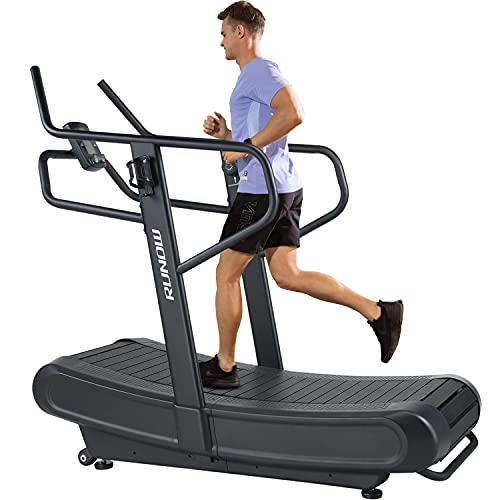
- Self-powered with four resistance levels
- 450-pound recommended capacity
- 5-inch LCD tracks key workout metrics
Best For: Runners and HIIT users wanting a high-capacity training treadmill
Space-Saving Pace Control

- Eight adjustable resistance levels
- 59-inch non-slip running belt
- Foldable design with transport wheels
Best For: Home users prioritizing storage and adjustable manual resistance
Connected Home Workouts
Sunny Health & Fitness Smart Curved Treadmill

- Free SunnyFit app access via Bluetooth
- Eight magnetic resistance levels
- 59-by-17.7-inch anti-slip running surface
Best For: Home runners wanting connected workouts and app-based training
Wide-Belt Endurance Training

- 63-by-19-inch curved running belt
- Four resistance levels for varied intensity
- Approximately 450-pound capacity
Best For: Serious runners and athletes training on a spacious platform
Best Budget-Friendly Pick
Foldable Curved Treadmill for Home Running

- Self-propelled track with no speed limit
- Folds for easier storage and has transport wheels
- 350-pound capacity with LED workout display
Best For: Home running and sprint training in space-conscious rooms
Best Commercial-Style Option
SB Fitness CT400 Curved Treadmill
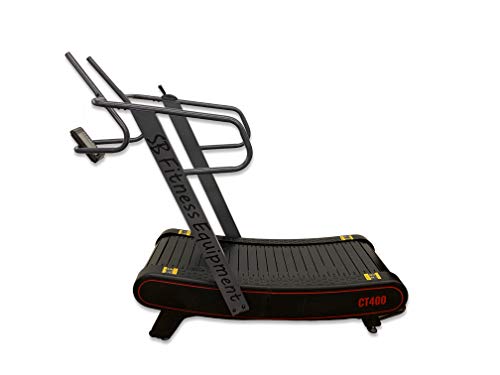
- Three adjustable resistance levels for varied training
- Long 60-inch deck and 18-inch running width
- Built for running, HIIT, and sport-specific workouts
Best For: Athletes and gyms wanting a larger, resistance-equipped treadmill
Best Heavy-Duty Pick
High-Capacity Curved Treadmill with Resistance

- Heavy-duty frame with a listed 660-pound capacity
- Wide, long running area for varied strides
- Adjustable resistance and detailed LED performance tracking
Best For: Heavy-duty home-gym training, intervals, and sprint workouts
Versatile Training Pick

- 8-level magnetic resistance
- LCD tracks key workout metrics
- 350-pound capacity and 5-year warranty
Best For: Home and light-commercial running, HIIT, and interval training
Heavy-Duty Manual Choice

- 8-level resistance with training modes
- Self-powered and non-electric
- 440-pound stated weight capacity
Best For: Home gyms and studios needing structured manual cardio training
Conditioning-Focused Pick

- Six-level metal resistance control
- Five-layer shock-absorbing belt
- 400-pound stated weight capacity
Best For: HIIT, interval sprints, and serious home or light-commercial conditioning
Commercial-Ready Training – RUNOW Curved Treadmill
The RUNOW Curved Treadmill is a strong option for runners seeking a curved treadmill for running training with self-paced speed control. Its non-electric design supports walking, jogging, sprinting, and HIIT, while four resistance levels and a 450-pound capacity suit demanding workouts.
Best For: Athletes, runners, and home or commercial gyms needing a durable, high-capacity manual treadmill.
Pros:
- Self-powered operation has no motor-driven speed limit and allows quick pace changes.
- Four manual resistance levels support jogging, sprinting, and HIIT sessions.
- Tracks time, distance, calories, speed, pace, wattage, and resistance on the 5-inch LCD.
- Commercial-grade alloy-steel construction supports users up to 450 pounds.
Cons:
- At 287 pounds, it is substantially heavier than many home treadmills.
- The 48-inch deck is shorter than the belt on some competing curved models.
- Its commercial-grade size may require considerable floor space.
Choose this RUNOW model when stability, capacity, and training versatility matter more than portability. The transport wheels and low-maintenance belt help with repositioning and upkeep, but its heavy frame is best suited to a dedicated workout area.
Space-Saving Pace Control – Foldable Manual Treadmill
Rongle Manual Treadmill, Adjustable Resistance, Foldable, LED Display, Supports up to 350 lbs
Check Price On AmazonThis foldable manual treadmill is a practical pick for a curved treadmill for running training when storage matters. Its non-powered belt lets you walk, jog, or sprint at your own pace, while the zoned deck helps users accelerate, maintain speed, and slow down naturally.
Best For: Home or office users who want adjustable resistance and a foldable, easier-to-move design.
Pros:
- No speed restriction lets users control pace through their movement.
- Eight resistance levels provide more adjustment than many four-level models.
- The 59-inch non-slip belt offers useful running space.
- LED display monitors time, calories, speed, distance, pace, and heart rate.
Cons:
- The supplied details list a 300-pound maximum weight recommendation, despite the title stating 350 pounds.
- No warranty service is listed.
- The included display is described as LED rather than a connected training console.
The R800A emphasizes adaptable workouts and convenient storage. Verify the applicable weight limit before purchase, and consider the absence of listed warranty service when comparing it with better-supported alternatives.
Connected Home Workouts – Sunny Health & Fitness Smart Curved Treadmill
The Sunny Health & Fitness Smart Curved Treadmill combines a natural-feeling manual belt with app connectivity, making it a versatile choice for a curved treadmill for running training at home. Its 59-by-17.7-inch surface, eight magnetic resistance levels, and no-speed-limit design support walking through sprinting.
Best For: Home runners who want app-guided workouts, virtual tours, and adjustable resistance.
Pros:
- Bluetooth access to the SunnyFit app includes trainer-led workouts and virtual scenic tours without membership fees.
- Eight magnetic resistance levels allow varied training intensity.
- Wide, anti-slip belt and shock absorption support comfortable running.
- Display tracks time, calories, speed, distance, pace, and pulse with a separately sold HR200 monitor.
Cons:
- The treadmill is designed for home use rather than commercial-grade training.
- Pulse tracking requires the separately sold HR200 monitor.
- The 330-pound capacity is lower than the 450-pound capacity of some alternatives.
Sunny’s model is a balanced choice for users who value guided digital content and a broad running surface. The magnetic resistance and mobility features add flexibility, while the home-use rating and lower capacity should guide placement and user selection.
Wide-Belt Endurance Training – Commercial Manual Air Runner
This commercial-grade air runner is built for runners who need a spacious curved treadmill for running training and high-intensity work. Its 63-by-19-inch belt, self-powered operation, four resistance levels, and approximately 450-pound capacity accommodate everything from walking to sprinting and HIIT.
Best For: Serious runners and athletes seeking a wide, stable platform for endurance and interval training.
Pros:
- Extra-wide, extra-long running surface provides room for varied strides.
- Four resistance levels support light jogging through high-intensity sprint work.
- Self-powered belt responds quickly when moving forward to accelerate or backward to slow down.
- Heavy-duty steel construction and reinforced platform are designed for intense workouts.
Cons:
- The 79-inch length and 35-inch width require substantial floor space.
- Its commercial construction may be excessive for casual walkers.
- The listed maximum speed is 25 kilometers per hour, not 25 miles per hour.
With its broad belt and reinforced frame, this model is particularly well suited to demanding running and HIIT sessions. It is a compelling choice for dedicated training spaces, provided you have room for its large footprint and do not need a motorized incline or speed system.
Best Budget-Friendly Pick – Foldable Curved Treadmill for Home Running
If you want a curved treadmill for running training without a motor, this foldable model emphasizes user-controlled pacing and space-saving storage. Its curved deck encourages a forward lean, while the zoned track helps with accelerating, cruising, and slowing down.
Best For: Home users who want a manually powered treadmill for running, sprint practice, and compact storage.
Pros:
- Self-propelled design has no speed limit and requires no outlet.
- Foldable handrails and transport wheels make storage and repositioning easier.
- Non-slip rubber track measures 51.2 inches long and supports up to 350 pounds.
- LED display tracks time, calories, speed, and distance.
Cons:
- The 15.75-inch track width is narrower than the other options here.
- It offers a single manual workout configuration rather than adjustable resistance levels.
This is a practical choice for runners who prioritize a simple, compact machine and natural pace control. The two-year warranty and durability testing add reassurance for regular home use.
Best Commercial-Style Option – SB Fitness CT400 Curved Treadmill
The SB Fitness CT400 is a strong candidate for a curved treadmill for running training when you want a larger deck and adjustable resistance. Its self-generated design responds quickly to pace changes, making it suitable for steady running, sport-specific drills, and HIIT.
Best For: Athletes, gyms, and serious home users who need a commercial-style curved treadmill with resistance control.
Pros:
- Three resistance levels let you vary workout difficulty.
- The 60-by-18-inch deck provides more running space than the compact home model.
- Self-generated operation supports immediate speed changes and unlimited pace.
- Digital display tracks time, distance, speed, calories, and total miles.
Cons:
- At 72 inches long and 145 pounds, it requires more floor space and is harder to move than a compact treadmill.
- The listing identifies this unit as open-box, so condition should be verified before purchase.
- Its commercial-style build may be more machine than casual walkers need.
With a steel frame, shock-absorbing track slats, and a stated 375-pound weight recommendation, the CT400 is geared toward demanding training. Its long warranty coverage is another advantage for frequent use.
Best Heavy-Duty Pick – High-Capacity Curved Treadmill with Resistance
For runners seeking a curved treadmill for running training with extra capacity and workout customization, this non-electric model combines a wide running area with adjustable resistance. It is designed for walking, jogging, sprinting, and interval sessions while providing onboard workout tracking.
Best For: Athletes, heavier users, and home-gym owners who want a sturdy, non-electric treadmill for varied training.
Pros:
- Adjustable resistance supports customized intensity and interval work.
- The running area is listed at up to 66.5 inches long and 27.2 inches wide, offering generous space.
- Heavy-duty construction has a stated 660-pound maximum recommendation.
- LED display tracks time, distance, pace, calories, speed, and heart rate.
Cons:
- The treadmill is not foldable and weighs about 220 pounds, limiting portability.
- Its large footprint is less suitable for small rooms.
- The supplied listing gives conflicting dimensions and resistance descriptions, so specifications should be confirmed before ordering.
This is the most substantial option in the group for users who value stability, belt space, and resistance-based progression. Transport wheels help with repositioning, but its commercial-grade size calls for a dedicated workout area.
Versatile Training Pick – SB Fitness CT550
The SB Fitness CT550 is a practical curved treadmill for running training, interval work, jogging, and walking. Its self-generated design needs no motor power, while eight magnetic resistance levels let you adjust the challenge for different workouts.
Best For: Home users and light-commercial settings that want adjustable resistance, basic workout tracking, and a sturdy 350-pound capacity.
Pros:
- Eight levels of magnetic resistance support customized workout intensity.
- Backlit LCD tracks time, speed, distance, calories, and heart rate.
- 20-inch-wide running surface and built-in water bottle holder improve usability.
- Self-generated operation avoids dependence on a powered treadmill motor.
Cons:
- The 20-inch deck length may feel limited for users wanting a longer running stride.
- Its light-commercial grade may not suit heavy, high-volume commercial use.
With a stated maximum speed of 22 mph and support for running, HIIT, and interval training, the CT550 is a flexible option. Its five-year manufacturer warranty also adds reassurance for buyers planning regular use.
Heavy-Duty Manual Choice – 2026 Curved Treadmill
This manual curved treadmill for running training combines an eight-level magnetic resistance system with a self-powered belt. Its digital display supports several goal-based modes, making it useful for structured cardio and anaerobic sessions without requiring an electrical outlet.
Best For: Home gyms, studios, and users who prioritize a high stated weight capacity, multiple training modes, and quiet non-electric operation.
Pros:
- Eight resistance levels accommodate walking, running, and sprint-focused workouts.
- LCD display monitors time, distance, pace, calories, speed, and heart rate.
- Self-powered operation requires no electricity and supports flexible placement.
- Transport wheels help with repositioning, and the stated weight capacity is 440 pounds.
Cons:
- At 354 pounds, the treadmill is substantial and may be difficult to move frequently.
- The 1.5-year warranty is shorter than the warranty listed for some competing options.
- Its 77.17-inch depth requires careful space planning.
The curved, shock-absorbing belt is designed to encourage a natural running motion, while interval, custom-time, distance, and calorie modes add workout flexibility. This is a sizable choice for buyers seeking a robust manual platform rather than a compact treadmill.
Conditioning-Focused Pick – 6-Level Manual Treadmill
Designed for demanding conditioning, this curved treadmill for running training uses a self-powered belt and six-level metal resistance knob. The long running belt, shock-absorbing construction, and manual speed response make it suited to intervals, sprints, and other effort-driven workouts.
Best For: Runners, HIIT users, and light-commercial gyms seeking a heavy-duty, non-electric machine with a 400-pound stated capacity.
Pros:
- Six resistance levels provide adjustable intensity for walking through sprint training.
- Five-layer belt construction is designed for shock absorption and grip.
- Long 94.5-inch by 16.5-inch running belt supports full strides.
- Digital monitor tracks speed, time, distance, calories, pulse, and wattage.
Cons:
- The 16.5-inch belt width is narrower than the CT550’s listed 20-inch surface.
- At 316 pounds, it is not an especially portable treadmill despite transport wheels.
- The listed one-year warranty is relatively limited.
Its all-mechanical design eliminates motor and circuit-board components, while the manufacturer describes operation below 40 dB. Buyers should still verify the product specifications before purchase, since the supplied details contain inconsistent maximum-speed information.
How We Picked the Best Curved Treadmill for Running Training
We focused on the features that matter most when choosing a Curved Treadmill for Running Training: self-powered belt performance, resistance adjustment, running-surface design, stability, weight capacity, display functions, and overall suitability for home or light-commercial use. We also considered whether each machine is foldable or easier to move, since curved treadmills can be substantial pieces of equipment.
Because specifications and included features can vary by model, confirm the current manufacturer listing for dimensions, warranty coverage, assembly requirements, and maximum user weight before ordering.
Quick Comparison
- Best for straightforward home training: Choose a foldable or compact manual model with a clear LED display and a suitable weight rating.
- Best for adjustable intensity: Look for multiple resistance levels, which make it easier to alternate between easy running, tempo work, and sprint-style efforts.
- Best for frequent or shared use: Commercial-oriented models with sturdier frames and self-generated power are better suited to heavier use.
- Best for natural pacing: A responsive curved belt lets your stride determine speed without relying on a motor or preset top speed.
Key Buying Factors for a Curved Treadmill for Running Training
Resistance and Belt Response
Resistance settings change how much effort is required to move the belt. More levels provide finer control, while a smooth, responsive belt is especially important for intervals and faster running. Beginners may prefer a lighter setting; experienced runners often want stronger resistance for conditioning.
Running Surface and Shock Absorption
Check the belt length and width against your stride and running style. A longer, wider surface generally feels more secure for faster workouts. Shock-absorbing layers or slats can reduce impact, but the exact feel varies, so prioritize a stable deck and consistent belt movement.
Capacity, Footprint, and Mobility
Match the stated user capacity with a comfortable margin rather than choosing the lowest acceptable rating. Measure ceiling height, floor space, and clearance around the machine. Foldable designs can help in smaller rooms, while commercial frames usually require a permanent setup.
Display and Power Requirements
Most manual models show basic metrics such as time, speed, distance, or calories. Self-generated displays avoid an outlet, but advanced training features may be limited. If you need structured workouts, heart-rate tracking, or app connectivity, verify those features specifically rather than assuming they are included.
Who Should Buy Which Curved Treadmill for Running Training?
Choose a compact foldable model if you train at home, have limited space, and need easy storage. Choose a model with four to eight resistance levels if your workouts include progression, hills, intervals, or multiple users. Choose a commercial-style treadmill if durability, stability, and frequent use matter more than portability. Choose a simpler self-powered runner if you want a low-maintenance machine that supports natural pacing without motor speed limits.
Before buying, compare the belt dimensions, resistance system, maximum user weight, warranty, and return policy. Those details usually have more impact on long-term satisfaction than the number of display readouts or accessory features.