The best compact emergency radios provide critical weather updates, backup power, and dependable lighting when storms or outages disrupt everyday technology. The models in this roundup combine features such as NOAA alerts, AM/FM reception, solar panels, hand-crank charging, and USB phone support.
Use the guide below to compare power capacity, charging options, portability, lighting, and ease of use so you can choose a radio that fits your emergency kit, vehicle, home, or outdoor plans.
Best 10 Compact Emergency Radios Picks for 2026
Best Compact All-Rounder
RunningSnail MD-088S Emergency Radio

- AM/FM/NOAA reception in a 5-inch body
- 2000mAh battery with crank and solar charging
- Bright LED flashlight and USB device charging
Best For: Portable emergency kits, camping, and everyday power outages
Best High-Capacity Pick
Roxicosly CR1030 Emergency Weather Radio

- Stated 12000mAh battery for device charging
- Large solar panel and efficient hand crank
- 5W flashlight, reading lamp, NOAA alerts, and IPX6 rating
Best For: Extended outages, rugged outdoor use, and high-power emergency kits
Best Lightweight SOS Option

- 0.51-pound pocket-sized design
- 3W three-LED flashlight rated at 140 lumens
- 80-decibel-plus SOS alarm and three charging options
Best For: Go-bags, hiking, and personal emergency carry
Reliable All-Rounder
FosPower A1 NOAA Emergency Radio

- Four power options: solar, hand crank, USB, and AAA batteries
- NOAA, AM/FM reception with flashlight, reading light, and SOS alarm
- 2,000mAh power bank for emergency phone or tablet power
Best For: Home emergency kits and everyday storm preparedness
Feature-Packed Portable
NITIGO 4000mAh Emergency Radio

- 4,000mAh battery supports emergency USB device charging
- Solar, hand-crank, and USB charging provide flexible power
- Includes NOAA/AM/FM reception, dual lights, SOS, and headphones
Best For: Go-bags, outdoor trips, and multipurpose emergency preparedness
High-Capacity Outdoor Option
Leaton 10000mAh Emergency Radio

- 10,000mAh battery with 5V/1A USB emergency output
- IPX6 water resistance, compass, and three-mode flashlight
- Manual NOAA/AM/FM tuning with solar, crank, and USB-C charging
Best For: Camping, RV travel, and extended emergency backup power
Best Pocket Pick
Esky Emergency Hand Crank Radio

- USB-C, solar, and hand-crank charging
- 2000mAh battery with up to 9 hours of radio use
- Compact 7.55-ounce design with 140-lumen flashlight
Best For: Lightweight emergency kits and camping
Best Heavy-Duty Pick
QAUYYW 20000mAh Emergency Radio

- 20,000mAh battery with up to 35 hours of radio use
- USB-C, solar, and hand-crank charging
- IPX6 waterproof build with phone charging and multiple lights
Best For: Extended outages and storm preparedness
Best Balanced Design
WVL Portable Emergency Weather Radio
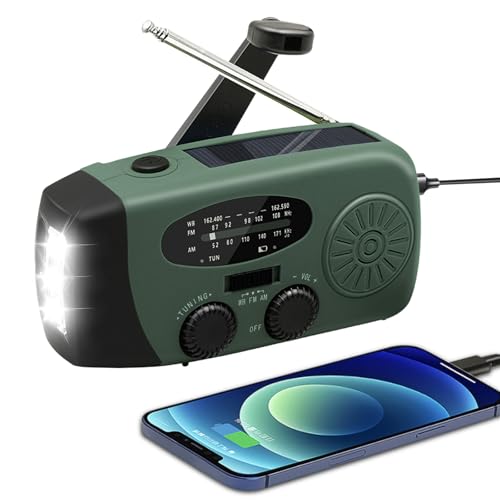
- Compact 231g body with flashlight and reading lamp
- Hand-crank, solar, and rechargeable battery power
- 2000mAh phone charger with AM/FM/WB and NOAA channels
Best For: Portable home-and-outdoor emergency kits
Best Compact All-Rounder – RunningSnail MD-088S Emergency Radio
For shoppers comparing compact emergency radios, the RunningSnail MD-088S combines weather updates, backup power, and lighting in a notably small 5 x 1.8 x 2.4-inch body. It receives AM, FM, and NOAA broadcasts and can be powered by its rechargeable battery, hand crank, or solar panel.
Best For: Home emergency kits, camping, and anyone who wants a lightweight radio with basic phone-charging capability.
Pros:
- Compact 0.5-pound design is easy to store or carry.
- Three power options: rechargeable battery, hand crank, and solar panel.
- Includes a 2000mAh battery, USB charging support, and a bright 1W LED flashlight.
- Receives AM, FM, and NOAA broadcasts.
Cons:
- Smaller battery capacity than several larger emergency radios.
- Water resistance is listed as water repellent rather than fully waterproof.
The RunningSnail is a practical choice when portability matters most. Its essential emergency features fit into a pocket-friendly enclosure, though users needing extended power storage or stronger weather protection may prefer a larger model.
Best High-Capacity Pick – Roxicosly CR1030 Emergency Weather Radio
The Roxicosly CR1030 stands out among compact emergency radios for its stated real 12000mAh battery, large solar panel, and multiple charging methods. It also adds NOAA alerts, dual lighting, an SOS alarm, and IPX6 waterproofing for more demanding outdoor or blackout use.
Best For: Buyers who prioritize extended backup power, bright lighting, and rugged weather resistance for home or outdoor emergencies.
Pros:
- Large stated 12000mAh battery can charge phones and other compatible devices.
- 8500mm² monocrystalline solar panel and efficient hand-crank generator provide backup charging.
- Combines a 5W adjustable-beam flashlight with a 12-LED reading lamp.
- Offers AM, FM, and seven NOAA bands, plus an SOS alarm and IPX6 waterproofing.
Cons:
- At about 824 grams and 6.8 x 2.88 x 4.74 inches, it is less pocket-friendly than smaller radios.
- Its feature-rich design may be more than needed for simple emergency listening.
This model is aimed at preparedness users who want substantial power and stronger outdoor capability in one unit. It trades away some portability for battery capacity, lighting versatility, and water protection.
Best Lightweight SOS Option – Emgykit 086S Hand Crank Radio
The Emgykit 086S is one of the more portable compact emergency radios, measuring about 5.1 x 2.1 x 2.4 inches and weighing 0.51 pounds. Along with AM, FM, and NOAA reception, it provides a 3W LED flashlight, an 80-decibel-plus SOS siren, and three charging methods.
Best For: Lightweight go-bags, hiking, and emergency kits where an audible distress signal is especially useful.
Pros:
- Pocket-sized design is easy to carry and store.
- 3W, three-LED flashlight provides up to 140 lumens of stated brightness.
- SOS function produces a siren louder than 80 decibels to attract attention.
- Supports hand-crank, solar, and Type-C charging, with a built-in 2000mAh battery.
Cons:
- Its 2000mAh battery is modest compared with high-capacity alternatives.
- Speaker output is listed at 1 watt, so it may be less suited to filling a large space with sound.
The Emgykit focuses on portability and signaling rather than maximum battery capacity. It is a sensible compact choice for personal emergency carry, especially when a bright light and SOS alarm matter as much as radio reception.
Best Cable-Convenient Pick – PRUNUS J-366 Emergency Radio
The PRUNUS J-366 is a convenient option among compact emergency radios because its built-in 3-in-1 cable supports Lightning, USB-C, and Micro USB devices. Its 5.6 x 2 x 2.7-inch, 8.6-ounce design also includes NOAA alerts, AM/FM reception, five power options, an SOS alarm, and a hand-crank flashlight.
Best For: Emergency kits shared by households with different phones and users who want charging cables built into the radio.
Pros:
- Built-in Lightning, USB-C, and Micro USB cables reduce the need to pack separate cables.
- Five power options include USB-C, hand crank, solar, built-in battery, and AAA batteries.
- NOAA alert mode provides audible warnings for severe weather notifications.
- Compact 8.6-ounce body includes an SOS alarm and flashlight.
Cons:
- AAA batteries are not included.
- The supplied details list the tuner type as FM, although the product also supports AM and NOAA bands.
- Specific flashlight brightness and water-resistance details are not provided in the supplied information.
The J-366 is especially practical for family preparedness because its integrated cables cover several common device connectors. Its small size and multiple power sources make it easy to keep ready, while the alert mode adds useful warning capability during severe weather.
Reliable All-Rounder – FosPower A1 NOAA Emergency Radio
The FosPower A1 is a practical choice for anyone comparing compact emergency radios for power outages, severe weather, or travel. It combines AM/FM/NOAA reception with solar, hand-crank, AAA-battery, and USB charging options, plus a 2,000mAh power bank for small devices.
Best For: Home emergency kits, weather preparedness, and users who want several backup power options in a compact radio.
Pros:
- Supports solar, hand-crank, USB, and four AAA batteries.
- Includes NOAA weather broadcasts, AM/FM radio, an SOS alarm, and two lighting options.
- 2,000mAh power bank can provide emergency power to a phone or small tablet.
- Water-resistant construction and a limited lifetime warranty add practical reassurance.
Cons:
- The power bank is smaller than the batteries in some competing models.
- AAA batteries are required but not included in the supplied details.
With its straightforward feature set and multiple ways to stay powered, the FosPower A1 is a balanced compact emergency radio for general preparedness. Its smaller power bank is best viewed as a backup charging option rather than a high-capacity battery.
Feature-Packed Portable – NITIGO 4000mAh Emergency Radio
The NITIGO is a versatile pick among compact emergency radios, pairing NOAA, AM, and FM reception with a 4,000mAh rechargeable battery. Its solar panel, hand crank, and USB charging support make it useful when precharging is difficult or grid power is unavailable.
Best For: Go-bags, travel, outdoor activities, and households wanting emergency lighting and device charging in one portable unit.
Pros:
- 4,000mAh battery can provide emergency power to USB devices such as smartphones.
- Offers solar, hand-crank, and USB charging methods.
- High-gain antenna is designed for clear AM/FM/NOAA reception.
- Combines a flashlight, rotating reading lamp, SOS alarm, flashing light, and headphone jack.
Cons:
- The supplied details do not specify the product’s exact dimensions or weight.
- Its many functions may be more than needed for shoppers seeking a basic radio.
The NITIGO stands out when versatility matters. The larger battery and extra lighting features make it a strong multipurpose emergency tool, while waterproof construction adds suitability for outdoor use.
High-Capacity Outdoor Option – Leaton 10000mAh Emergency Radio
The Leaton emphasizes battery capacity and outdoor readiness for shoppers seeking compact emergency radios with extended backup power. It includes a 10,000mAh internal battery, solar and hand-crank charging, USB-C input, NOAA/AM/FM reception, and IPX6 water resistance.
Best For: Emergency kits, camping, RV travel, and users who prioritize a larger built-in battery and splash-resistant construction.
Pros:
- 10,000mAh battery provides backup power through a 5V/1A USB output.
- IPX6 water resistance helps protect against water spray and splashing.
- Supports USB-C, solar, and hand-crank charging.
- Includes three flashlight modes, a 1.3W reading lamp, SOS signaling, and a compass.
Cons:
- NOAA broadcasts require manual tuning and do not include SAME or automatic alerts.
- The product is splash-resistant, not intended for immersion or heavy rain.
- Actual phone charging is limited by conversion loss; the notes estimate about 1–1.5 iPhone 14 charges.
The Leaton is a compelling choice when battery capacity and outdoor durability matter more than the lightest possible design. Its manual NOAA tuning and realistic charging limits are important tradeoffs to understand before buying.
Best Pocket Pick – Esky Emergency Hand Crank Radio
For shoppers seeking compact emergency radios, the Esky ES-CR01 combines AM/FM/NOAA listening with three charging options, a bright flashlight, and an SOS alarm. At 5 inches long and 7.55 ounces, it is easy to keep in a pocket, trunk, or emergency bag.
Best For: Lightweight emergency kits, camping, and everyday backup lighting.
Pros:
- Charges by USB-C, solar panel, or hand crank.
- 2000mAh battery provides up to 9 hours of radio use or about 20 hours of flashlight use when fully charged.
- 140-lumen, three-LED flashlight and SOS alarm add useful emergency functions.
- Compact 5-by-1.8-by-2.4-inch design with an attached lanyard.
Cons:
- Its 2000mAh battery is smaller than some high-capacity emergency radios.
- Supplied details do not indicate a waterproof rating.
The Esky is a practical choice when portability matters most. Its modest battery capacity is balanced by flexible recharging and a strong light, making it well suited to grab-and-go preparedness.
Best Heavy-Duty Pick – QAUYYW 20000mAh Emergency Radio
The QAUYYW stands out among compact emergency radios for its 20,000mAh battery and ability to provide USB charging for a phone or other device. It also includes AM/FM/NOAA/SW reception, multiple lights, an SOS alarm, and an IPX6 waterproof design.
Best For: Extended outages, storm preparedness, and users who prioritize battery capacity.
Pros:
- Large 20,000mAh battery supports up to 35 hours of radio use at medium volume.
- Charges through USB-C, solar power, or hand crank.
- Includes a 3W flashlight, 3.5W reading lamp, and SOS alarm.
- IPX6 waterproof construction and a 52cm extended antenna support outdoor use and reception.
Cons:
- NOAA alerts require the radio to be powered on and manually tuned to a local station.
- The supplied notes do not provide exact dimensions or weight.
- Its larger battery may make it less ideal for ultra-light carry than smaller models.
This model is the strongest fit for buyers who want long runtime and emergency phone-charging capability. Its manual tuning requirement is worth noting, but the waterproof build and high-capacity battery add substantial preparedness value.
Best Balanced Design – WVL Portable Emergency Weather Radio
The WVL is a balanced option for shoppers comparing compact emergency radios, pairing a pocket-sized body with AM/FM/WB reception, three power sources, a phone-charging function, and two lighting modes. Its 130-by-50-by-60mm size and 231g weight make it manageable for emergency bags and outdoor trips.
Best For: Portable home-and-outdoor kits that need lighting and basic device charging.
Pros:
- Built-in 2000mAh charger can provide emergency power to a small tablet or phone.
- Uses hand crank, solar panel, or built-in rechargeable battery power.
- Combines a 1.5W LED flashlight with a motion-sensor reading lamp.
- Includes AM/FM/WB tuning, NOAA weather channels, and an SOS alarm.
Cons:
- Its battery capacity is considerably lower than high-capacity emergency radio models.
- The supplied details list the tuner as AM and do not specify detailed NOAA tuning controls.
- It is heavier than the smallest pocket radios at 231g.
The WVL offers a useful middle ground: it remains compact while adding a reading lamp and phone-charging output. Choose it when portability, lighting, and basic weather-radio coverage matter more than maximum battery runtime.
How We Picked the Best Compact Emergency Radios
We focused on practical emergency features rather than appearance alone. Each selected radio supports multiple power or charging methods, including hand cranks, solar charging, batteries, or USB input. We also considered NOAA weather-band access, alert functionality, built-in lighting, phone-charging capability, portability, and battery capacity.
Because published capacity figures and feature combinations vary, treat battery ratings as useful comparisons rather than guarantees of runtime. Actual performance depends on signal strength, lighting use, charging conditions, and how often the radio is operated.
Quick Comparison
- Best for broad preparedness: Choose a model with NOAA alerts, AM/FM reception, solar and hand-crank charging, and a high-capacity battery.
- Best for compact kits: Prioritize a lightweight design with a simple crank, clear controls, and an integrated flashlight.
- Best for family use: Look for readable controls, multiple lighting modes, and enough battery capacity to support repeated use.
- Best for phone backup: Select a radio with a clearly specified USB output and compatible charging cables or adapters.
Key Buying Factors for Compact Emergency Radios
Power and Charging Options
Hand-crank charging is useful when the battery is depleted, while solar charging can maintain power during extended outages if the panel receives strong sunlight. USB input is convenient before an emergency. A larger battery may offer more phone-charging potential, but it can also increase weight and require longer charging times.
Weather Alerts and Reception
NOAA weather-band reception is one of the most important reasons to buy an emergency radio. Confirm that the model supports NOAA alerts if you want automatic warnings, and check whether the antenna and tuning controls are easy to use. AM/FM support adds general news and local broadcast access.
Lighting and Practical Design
A flashlight is valuable during outages, while a reading lamp can illuminate a wider area. Consider brightness controls, multiple modes, a stable shape, water resistance, handle comfort, and whether the radio is small enough for your emergency bag or vehicle compartment.
Phone Charging and Capacity
Phone charging can be useful for emergency communication, but it should be treated as a backup feature rather than a replacement for a power bank. Check connector compatibility, output specifications, and whether the radio can charge a device while using the crank or solar panel.
Who Should Buy Which Compact Emergency Radios?
Choose a feature-rich, higher-capacity model for a home emergency station or frequent severe-weather preparedness. A mid-capacity radio with reliable solar and hand-crank charging is a sensible choice for most households. For hiking, camping, or a small go-bag, favor compact size, low weight, durable controls, and a strong flashlight over maximum battery capacity.
Whichever model you choose, test the radio before storing it, keep it fully charged when possible, and periodically inspect the crank, solar panel, cable, and flashlight. Store it where every household member can find and operate it quickly.